Showing posts with label Civil War. Show all posts

Friday, May 15, 2009

A forever witness of a dead soldier


Chamberlain amidst death at Fredericksburg

In the preternatural cold night before Fredericksburg, sky alight with strange light, and haunting sounds of lead and shot and ball, missiles tearing through air and earth, flesh and blood and mud and bone, high-pitched whine of Minie balls and lower roar of cannon, hellish shriek of shell, Joshua Chamberlain lay on the battlefield with the torn remnants of his men from the 20th Maine. He survived only by lying among the stacked, faithful dead.

He spent the long cold night there, in horrid awe and wonder: sky dancing with Aurora Borealis so far South: what portent!

Wakened in the cold dawn by the renewed rifle fire, he made a sudden discovery. He moved his head -- pillowed on a corpse --, and from the pocket of the soldier that shielded him in death, a well-worn New Testament dropped out. Chamberlain was deeply moved. Listen to his words:

"Wakened by the sharp fire that spoke the dawn, as I lifted my head from its restful though strange pillow, there fell out from the breast pocket a much-worn little New Testament written in it the owner's name and home. I could do no less than take this to my keeping, resolved that it should be sent to that home in the sweet valley of the Susquehanna as a token that he who bore it had kept t he faith and fought the fight. I may add that sparing mercy allowed the wish to be fulfilled, and this evidence gave the stricken mother's name a place in the list of the nation's remembered benefactors."


Ah! What honor! The loyalty that kept Chamberlain at post, even with all hope gone; the last breath of this dead soldier, who even in death witnessed to life and saved a special life with his body; the enduring Word of God that sustained him to hopeless things -- shall this not echo into eternity?

Is this not what keeps my hand over my heart when I salute the flag?

Yeah, not the sins of my nation, but the destined valor of souls who gave their all that we might live -- live to be a light to the nations -- this, this captures my heart. I yet thrill when I hear the words, "America! America! God shed His grace on thee!"

And crown thy good with brotherhood, from sea to shining sea!

The words of Chamberlain, the life of this dead soldier... they live on.

Even with America plagued by those who hate what Chamberlain stood for... yea, something yet endures! In great deeds, something abides. On great fields, something stays. Forms pass and change, bodies disappear, but spirits linger, to consecrate ground as the vision-place of souls.

Selah.

Wednesday, March 11, 2009

A field of the loyal fallen


Stones River National Battlefield

Friday, March 06, 2009

Light and shadow on field of glory


Stones River National Battlefield
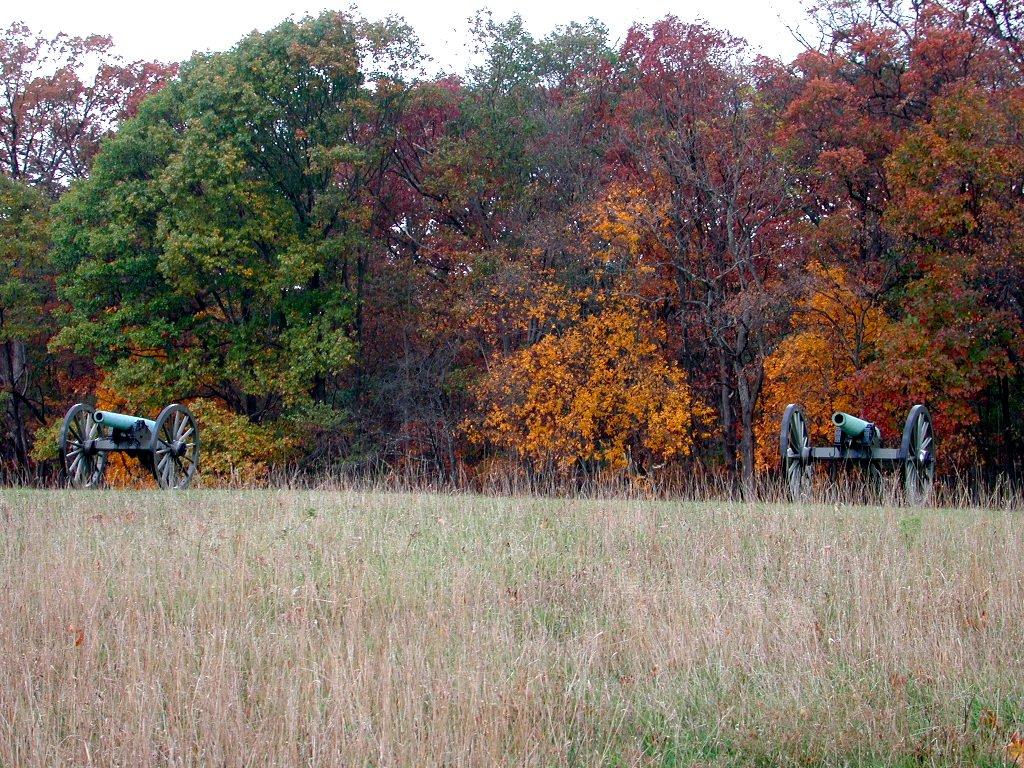
: Light and shadow, sun and snow illumine this field of the fallen.

Tuesday, September 20, 2005

Destiny in blood and fire at Gettysburg


Warrior of Providence

Piecing together the epic battle of Gettysburg, I’ve found such dramatic stories of Providence, that…in the words of one commander, ‘Only a fool or infidel could deny’ the hand of God in it all. Shelby Foote, the famous Civil War historian, once commented that it was ‘as if the very stars aligned in their courses against Lee’ at Gettysburg, to draw him into battle and then to cause him to throw his men away in Pickett’s [or Longstreet’s] charge on the third day.

And, that seems to be the case. The little details, the ‘chance’ occurrences of terrain, men and events, were arranged in such a way that the Federals won the battle. The more one studies the battle, the more these details pile up and leap out…as an avalanche of ‘improbable’ events, men and positions, piled one upon another, to turn back the Confederate tide.

Among this tide of providential details is the story of Col. Joshua L. Chamberlain and the 20th Maine.

I’ve commented before on the character of this man, and the actions of the 20th at Gettysburg. But here, I’d like to set up the context of those days in July so that readers can sense the power of events for themselves.

The battle at Gettysburg engaged on the first of July, where, by all accounts…the Confederates smashed the Federal troops, with heavy losses. The 20th Maine and the Fifth Corps spent this day marching, only to find themselves 16 or so miles from Gettysburg and the crucial battle by night’s end.


A night when the powers of another world drew nigh
July 1, 1863

The Fifth Corps marched to Hanover, Pennsylvania – Col. Chamberlain and the 20th Maine lay down by the road to get some rest…only to receive urgent orders: ‘Get up and march to Gettysburg!’
Nightfall brought us to Hanover, Pennsylvania, and to a halt. And it was the evening of the first day of July, 1863. All day we had been marching north from Maryland, searching and pushing out on all roads for the hoped-for collision with [Gen. Robert E.] Lee eagerly, hurriedly, yet cautiously, with skirmishers and flankers out to sound the first challenge, and our main body ready for the call…

Worn and famished we stacked arms in camping order, hoping to bivouac beside them… Some of the forage wagons had now got up, and there was a brief rally at their tail ends for quick justice to be dispensed. But the unregenerate fires had hardly blackened the coffee-dippers, and the hardtack hardly been hammered into working order by the bayonet shanks, when everything was stopped short by whispers of disaster away on the left: the enemy had struck our columns at Gettysburg, and driven it back with terrible loss; [John F.] Reynolds, the commander, had been killed, and the remnant scarcely able to hold on to the hillsides unless rescue came before morning. These were only rumors flitting owl-like, in the gathering shadows. We could not quite believe them, but they deepened our mood.

Suddenly the startling bugle-call from unseen headquarters! “The General!” it rang! “To the march! No moment of delay!”

Word was coming, too. Staff officers dashed from corps, to division, to brigade, to regiment, to battery and the order flew like the hawk, and not the owl. “To Gettysburg!” it said -- a forced march of sixteen miles. But what forced it? And what opposed? Not supper, nor sleep, nor sore feet and aching limbs.

In a moment, the whole corps was in marching order; rest, rations, earth itself forgotten; one thought -- to be first on that Gettysburg road. The iron-faced veterans were transformed to boys. They insisted on starting out with colors flying, so that even the night might know what manner of men were coming to redeem the day.

At a turn of the road a staff officer, with an air of authority, told each colonel as he came riding up, that McClellan was in command again, and riding ahead of us on the road. Then wild cheers rolled from the crowding column into the brooding sky, and the earth shook under the quickened tread. Now from a dark angle of the roadside came a whisper, whether from earthly or unearthly voice one cannot feel quite sure, that the august form of Washington had been seen that afternoon at sunset riding over the Gettysburg hills. Let no one smile at me! I half believed it myself -- so did the powers of the other world draw nigh![1]

So after their 12 hour march to Hanover, PA, without rest or cooked rations, they force-marched all night to reach Gettysburg by the 2nd of July.

Hold this ground at all costs!

July 2, 1863

They reached Gettysburg in the morning, and slept on their arms beside the road.

Again the bugle ordered them forward. They entered the field to general chaos and disorder. Amidst the shells and cries for help, Col. Vincent, their commanding officer, heard that Little Round Top was unprotected. Without divisional orders, immediately ordered the Fifth Corps forward, and placed the little 20th Maine on the end of the line.
Reaching the southern face of Little Round Top, I found Vincent there, with intense poise and look. He said with a voice of awe, as if translating the tables of the eternal law, ‘I place you here! This is the left of the Union line. You understand. You are to hold this ground at all costs!’

Chamberlain said that ‘he understood, but was yet to learn about costs.’ He prepared his men to fight ‘at all costs,’ i.e. to fight to the death, if need be.[2]

Captain Howard Prince later related the actions of Chamberlain in the moments before the battle:
Up and down the line, with a last word of encouragement or caution, walks the quiet man, whose calm exterior concealed the fire of the warrior and heart of steel, whose careful dispositions and ready resource, whose unswerving courage and audacious nerve in the last desperate crisis, are to crown himself and his faithful soldiers with...fadeless laurels.[3]

In less than 10 minutes they were attacked. They had literally reached the decisive point of the battle with only minutes to spare.

Immediately, members of the 4th and 47th Alabama regiments attacked their front, and the 20th Maine was hotly engaged.

During the attack, an adjutant alerted Chamberlain a movement of Confederates between the Round Tops towards his left flank. He climbed a rock to see this new development, and sure enough…behind the main attack line, the 500 man 15th Alabama under Colonel William C. Oates was stealthily moving to enfilade his left flank.

But he had no more men for the flank!

Coolly, he ordered his men to keep firing, and take several steps to the left. In this manner he lengthened the thin line, then doubled them back at a right angle. In military terms, this is called ‘refusing the line.’ And he did it under extreme fire, totally outmanned. When the 15th Alabama charged in, instead of crushing an unprotected line, they met a volley of fire, which stunned them and threw them back. “The execution of this difficult maneuver while under fire is a tribute to the regiment’s training and discipline and to Chamberlain’s resourcefulness.”[4]

However, this move, as brilliant as it was, only postponed the inevitable. The 20th Maine just simply didn’t’ have enough men or firepower to hold the position. Their line was spread too thin, and now almost doubled back upon itself.
The roar of all this tumult reached us on the left, and heightened the intensity of our resolve. Meanwhile the flanking column worked around to our left and joined with those before us in a fierce assault, which lasted with increasing fury for an intense hour. The two lines met and broke and mingled in the shock. The crush of musketry gave way to cuts and thrusts, grapplings and wrestlings. The edge of conflict swayed to and from, with wild whirlpools and eddies. At times I saw around me more of the enemy than of my own men: gaps opening, swallowing, closing again with sharp convulsive energy; squads of stalwart men who had cut their way through us, disappearing as if translated. All around, strange, mingled roar-shouts of defiance, rally, and desperation; and underneath, murmured entreaty and stifled moans; gasping prayers, snatches of Sabbath song, whispers of loved names; everywhere men torn and broken, staggering, creeping quivering on the earth, and dead faces with strangely fixed eyes staring stark into the sky. Things which cannot be told -- nor dreamed.

How men held on, each one knows, not I. But manhood commands admiration.

There was one fine young fellow, who had been cut down early in the fight with a ghastly wound across his forehead, and who I had thought might possibly be saved with prompt attention. So I had sent him back to our little field hospital, at least to die in peace. Within a half-hour, in a desperate rally I saw that noble youth amidst the rolling smoke as an apparition from the dead, with bloody bandage for the only covering of his head, in the thick of the fight, high-borne and pressing on as they that shall see death no more. I shall know him when I see him again, on whatever shore![5]

After an hour and a half of this desperate fighting, the little 20th Maine had nothing left to give. Facing 3-1 or 4-1 odds, on little sleep, two-days march, and low ammunition, they could not stand another blow. Six times the enemy had assaulted them. Five times their thin line had been penetrated and almost shattered. The seventh assault would be their last.
Our thin line was broken, and the enemy were in rear of the whole Round Top defense -- infantry, artillery, humanity itself -- with the Round Top and the day theirs. Now, too, our fire was slackening; our last rounds of shot had been fired; what I had sent for could not get to us. I saw the faces of my men one after another, when they had fired their last cartridge, turn anxiously towards mine for a moment; then square to the front again. To the front for them lay death; to the rear what they would die to save…

In his battle report, Chamberlain described it this way:
The enemy seemed to have gathered all their energies for their final assault. We had gotten our thin line into as good a shape as possible, when a strong force emerged from the scrub wood in the valley, as well as I could judge, in two lines in echelon by the right, and, opening a heavy fire, the first line came on as if they meant to sweep everything before them. We opened on them as well as we could with our scanty ammunition snatched from the field.

It did not seem possible to withstand another shock like this now coming on. Our loss had been severe. One-half of my left wing had fallen, and a third of my regiment lay just behind us, dead or badly wounded. At this moment my anxiety was increased by a great roar of musketry in my rear, on the farther or northerly slope of Little Round Top, apparently on the flank of the regular brigade, which was in support of Hazlett's battery on the crest behind us. The bullets from this attack struck into my left rear, and I feared that the enemy might have nearly surrounded the Little Round Top, and only a desperate chance was left for us. My ammunition was soon exhausted. My men were firing their last shot and getting ready to “club” their muskets.

It was imperative to strike before we were struck by this overwhelming force in a hand-to-hand fight, which we could not probably have withstood or survived. At that crisis, I ordered the bayonet. The word was enough. It ran like fire along the line, from man to man, and rose into a shout, with which they sprang forward upon the enemy, now not 30 yards away. The effect was surprising; many of the enemy's first line threw down their arms and surrendered. An officer fired his pistol at my head with one hand, while he handed me his sword with the other. Holding fast by our right, and swinging forward our left, we made an extended “right wheel,” before which the enemy's second line broke and fell back, fighting from tree to tree, many being captured, until we had swept the valley and cleared the front of nearly our entire brigade.[6]

It was a glorious, improbable victory. Entering the fight with 358 men, only 200 remained for the charge… In the charge, these 200 took 400 prisoners, from 5 different Confederate regiments…which gives a sense of the magnitude of the assault force before them – battle hardened regiments from Hood’s and Longstreet’s divisions yielding to a thin blue Federal line bereft of ammunition!

Colonel Oates of the 15th Alabama would later write: “There never were harder fighters than the 20th Maine men and their gallant Colonel. His skill and persistency and the great bravery of his men saved Little Round Top and the Army of the Potomac from defeat. Great events sometimes turn on comparatively small affairs.”[7]

Singular guidance of Providence

  • A scholar and professor, Chamberlain should not have been in battle. His college did not permit him to join, so he took several days leave of absence and signed up!
  • He was not West Point trained; yet he trained himself and the regiment into one of the best in the Union Army.
  • God gifted him with a brilliant mind, trained in classics, half dozen languages, and professor of logic, rhetoric and theology. He turned this brilliance toward understanding the art of war, and understanding men…gifted with the intuitive ability to react instantly to crucial battle demands. Chamberlain commented in a letter to his wife Fanny: “I study, I tell you, every military work I can find. And it is no small labor to master the evolutions of a Battalion and Brigade. I am bound to understand everything.”
  • Of all the Federal officers, none were more creatively equipped than Chamberlain -- intellectually, spiritually or martially -- to be in this exact position that July day in Gettysburg.
  • Of all the Federal regiments, none were more able, man for man, than the 20th Maine [who reflected the leadership of their Col., and trusted him implicitly] to be on the end of the line at Little Round Top.
  • Twice during the battle Chamberlain was wounded. And several times, seemingly protected by Providence: 1. An opposing officer fired a pistol in his face, point blank, only to have it misfire; 2. An opposing Alabama marksman twice had something ‘queer’ come down on him, when he had Chamberlain in his sights.
    Dear Sir: I want to tell you of a little passage in the battle of Round Top, Gettysburg concerning you and me, which I am now glad of. Twice in that fight I had your life in my hands. I got a safe place between two rocks, and drew bead fair and square on you. You were standing in the open behind the center of your line, full exposed. I knew your rank by your uniform and your actions, and I thought it a mighty good thing to put you out of the way. I rested my gun on the rock and took steady aim. I started to pull the trigger, but some queer notion stopped me. Then I got ashamed of my weakness and went through the same motions again. I had you, perfectly certain. But that same queer something shut right down on me. I couldn’t pull the trigger, and gave it up - that is, your life. I am glad of it now, and hope you are.[8]
The proving ground of tough circumstances

  • The 20th Maine formed at Camp Mason in Portland, and under Colonel Ames. Colonel Ames was a notoriously brutal commander, who drilled the men so hard that Chamberlain’s younger brother, Tom, feared that the men would shoot Ames at the first chance, commenting thus: “...Colonel Ames takes the men out to drill and he will damn them up hill and down... I tell you he is about as savage a man you ever saw.” Only after their first combat did the men realize that this over-the-top discipline ensured their survival. Their training made them as close to an elite fighting force as the Civil War knew.
  • The 20th Maine came to Gettysburg after enduring some of the most deadly fighting of the war, at Fredericksburg and Chancellorsville. Originally mustering close to 900 men, they reported to the line at Gettysburg with 358 men and 28 officers, and this including the addition of 120 court-martialed men from the 2nd Maine, whom Chamberlain convinced to fight with them.
  • The 20th Maine was the Marine Corps of the Federals: trained and proven in the harshest circumstances, almost as if for a single moment in time…holding the line on the rocky slopes of Little Round Top.

The spiritual nature of sacrifice for others

Chamberlain insisted, with great passion, that the sacrifice of his men at Gettysburg and on other fields, be characterized in spiritual terms, as part of the glorious cosmic war against darkness. For this honor, this high chivalry, he paid a price.

Some have said that his stubborn ethics, his code of valor cost him the Senate, and perhaps Presidency…as political enemies undermined him, since they couldn’t control him. But that’s just the kind of man he was. He would not sell out…no, not even for the Senate or President’s power.

The picture of the man is seen, years later, sitting on Little Round Top:
I sat there alone, on the storied crest, till the sun went down as it did before over the misty hills, and the darkness crept up the slopes, till from all earthly sight I was buried as with those before. But oh, what radiant companionship rose around, what steadfast ranks of power, what bearing of heroic souls. Oh, the glory that beamed through those nights and days. Nobody will ever know it here! I am sorry most of all for that the proud young valor that rose above the mortal, and then at last was mortal after all; the chivalry of hand and heart that in other days and other lands would have sent their names ringing down in song and story!

They did not know it themselves -- those boys of ours whose remembered faces in every home should be cherished symbols of the true, for life or death -- what were their lofty deeds of body, mind, heart, soul on that tremendous day.

Unknown -- but kept! The earth itself shall be its treasurer. It holds something of ours besides graves. These strange influences of material nature, its mountains and seas, its sunset skies and nights of stars, its colors and tones and odors, carry something of the mutual, reciprocal. It is a sympathy. On that other side it is represented to us as suffering: The whole creation travailing in pain together, in earnest expectation, waiting for the adoption -- having the right, then, to something which is to be its own.

And so these Gettysburg hills which lifted up such splendid valor, and drank in such high heart's blood, shall hold the mighty secret in their bosom till the great day of revelation and recompense, when these heights shall flame again with transfigured light -- they, too, have part in that adoption, which is the manifestation of the sons of God!

Rutherford B. Johnson comments:
Such characteristics of subordinating one's own selfish ends to the furtherance of a noble, important, and often life-and-death cause are sorely lacking in today's mainstream society. It is not that they do not exist, but rather that those feeling likewise are fewer today than in certain previous times, and often those feelings are greatly suppressed by popular culture. Yet, in this struggle for the preservation of freedom and indeed our very existence, such characteristics are most essential. Chief among these is moral courage and an inclination to carry out actions, when called, which, no matter how unpleasant or self-endangering, are essential to achieving victory.[9]

It is an abiding lesson of courage, and living to ‘the limits of the soul’s ideal.’

Such Providence, in making the man, and bringing the man to bear in these circumstances, should cause us to reflect on our own greatness, and place in the cosmic war between good and evil.

We were not at Gettysburg. But the good done in private, by a good man or woman, carries on the sacrifice…it ensures that the deeds of valor done on this field, and others, for freedom…were not done in vain. It also echoes again that that highest of deeds from the greatest Warrior of all time…on the Cross…still speaks for victory!

Brave hearts, good hearts, continue still…


Dust of heroes, we will know you...on whatever shore!

“In great deeds something abides. On great fields something stays. Forms change and pass; bodies disappear; but spirits linger, to consecrate ground for the vision-place of souls. And reverent men and women from afar, and generations that know us not and that we know not of, heart-drawn to see where and by whom great things were suffered and done for them, shall come to this deathless field, to ponder and dream; and lo! The shadow of a mighty presence shall wrap them in its bosom, and the power of the vision pass into their souls.”

_________________________

1 Joshua L. Chamberlain, Through Blood and Fire at Gettysburg, published in Gettysburg Magazine No. 6, January 1992 and also published online.
This casual hint of Chamberlain, ‘so did the powers of the other world draw nigh,’ intimates the first real ghost story of Gettysburg: The form of Gen. Washington, dead for 63 years, was reported on the road to Gettysburg, at a crossroads; and then, on the battlefield, at the crucial moment of the bayonet charge: So many of the 15th Alabama claimed to have seen the form of Washington leading the charge that the War Department investigated following the war. And, again, Chamberlain cryptically comments, “Those brave Alabama fellows-- none braver or better in either army--were victims…of their quick and mobile imagination.”
2 Michael Nugent comments:
Chamberlain fully understood the criticality of his mission. If the Confederate forces were able to flank his position, they would gain the rear of the entire Union line with disastrous results… What Chamberlain could not have known, was that in the event of a significant Confederate victory during General Robert E. Lee’s invasion of Pennsylvania, the leaders of the Confederacy intended to present President Lincoln with an offer to pursue a negotiated peace, potentially dividing the Country permanently. [Nugent, “Joshua L. Chamberlain: a Biographical Essay,” Military History Online .
3 Recounted by Pat Finegan, To the Limits of the Soul’s Ideal: My Tribute to Major General Joshua L. Chamberlain.
4 Nugent, “Chamberlain.”
5 Joshua L. Chamberlain, Through Blood and Fire at Gettysburg, published in Gettysburg Magazine No. 6, January 1992 and online.
6 Joshua Lawrence Chamberlain's Report of the Battle of Gettysburg (20th Maine), The American Civil War.
7 Quoted by Nugent, “Chamberlain.”
8 Chamberlain, Through Blood and Fire at Gettysburg.
9 Rutherford B. Johnson, A Personal Essay about Chamberlain's Philosophy, and its Modern Application.

Key resources for further study:

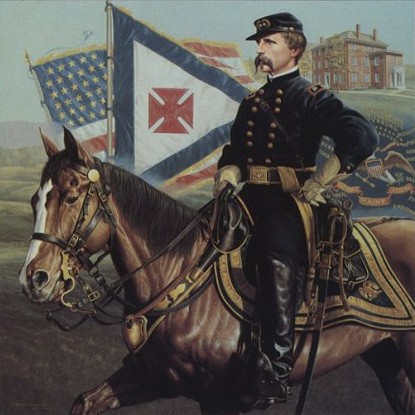
Joshua L. Chamberlain, Bayonet! Forward: My Civil War Reminences, Stan Clark Military Books, 1994. The opening picture of Chamberlain on the horse, colors behind him, is from the cover of this book.

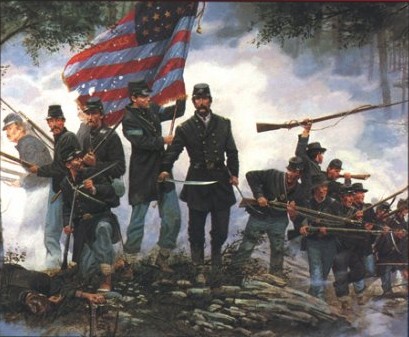
Joshua L. Chamberlain, Through Blood and Fire at Gettysburg, Stan Clark Military Books, 1994. The closing, fighting action picture of Chamberlain holding the sword, with the 20th Maine on Little Round Top, is from the cover of this book.

Alice Rains Trulock. In the Hands of Providence: Joshua L. Chamberlain and the American Civil War. Chapel Hill: University of North Carolina Press, 1992.

To the limits of the soul's ideal. This is a very informative website published by Pat Finegan, on Chamberlain. Lots of nuggets here, in these pages.


Wednesday, August 10, 2005

Tuesday, August 09, 2005

Gettysburg ghosts II


More documented stories


Several people responded well to my last Gettysburg post, with some requests for more...so, here are a few more stories to hold you over -- especially since I may not be able to Blog much for the next couple weeks.


But before I share these stories, I just have to add a caveat regarding 'ghost encounters.' Please be aware that not all ghost stories [or sightings, etc.] are equal. Not all are benevolent. And not all are human spirits. We live in a spiritual world with both good and evil, with humans called to choose sides, to actively live out good through our Lord Jesus Christ. And many manifestations do not encourage such true life under Christ...


There's a whole cottage industry grown up around ghosts and contacting 'the other side,' or "Crossing Over" as one show puts it. I am against that, strongly, for several reasons...which I'll be glad to share [if you email me]. There is also a very malevolent side to some 'ghost encounters,' which results in fear, control and possession.


However, much of what I hear about Gettysburg battlefield incidents makes them seem a different class, for several reasons: one, they are not sought after; two, they are usually seen by multiple witnesses; and three, under conditions which are known to mimic original battle conditions -- almost as if real events are dimly replaying through the fabric of time, with spirits of real men focused on a given mission, not on 'haunting' per se.


Many of these sightings occur during re-enactments of the Battle of Gettysburg, as if the replayed sights and sounds of the acted battle trigger some response in the unseen world. I've heard several amazing stories from the filming of
Gettysburg, filmed for several months in the summer of 1992. Some of these stories are very moving...like the thousands of men who reenacted Pickett's charge, as they moved through the waving fields of grain, being overcome by such great emotion that they began to spontaneously weep. One reenactor general on a horse, felt the wave of emotion, looked behind him only to find his two adjutants in open tears, streams covering their face as they strode with pride and sorrow toward the bloody stone wall. Literally hundreds of these men on this same charge tell of the hotness of the day -- one of the hottest on record -- and crossing that field in great heat...and tears...only to suddenly enter a swale where the temperature dipped below freezing. Looking at one another with shock and surprise, they saw their breath in the air...frozen...only to pop out on the other side, back into the relentless summer heat.


There's just something about the
Gettysburg battlefield. Once you've been there, and felt the greatness of the place, the mingled sorrow and joy, great devotion and peace, peace built upon unmatched turmoil and tears...you'll know what I mean. Great deeds were done on that day, which human tongue nor pen will ever tell.


Perhaps it is that sense of greatness, or duty, which compels me to memory of these men...in stories not of this world? Perhaps! Perhaps it is the fact that great heroes are dying, even as we speak, for freedom. Perhaps it is the fact that great deeds are being done, in the souls of great men and women, as they carry out duty unseen...for Christ. Perhaps!


And so, for your enjoyment, and recalled duty, here are several stories, most from the 1992 filming of
Gettysburg, witnessed by multiple persons. The stories here are chronicled and retold by Mark Nesbitt. The first is one of my favorites, of Confederate battalion forming for battle in a thunderstorm...

No reenactor is foolish enough to march around in a thunderstorm.


One night during the first few days of August a typical summer thunderstorm with lightning, roiling thunder, and a solid wall of rain advanced, like some infernal army, from the bins to the west across the encampment site. A lone reenactor ventured from his tent out into the night to watch the majesty of the battle in the sky, and was surprised and a little shocked to see a battalion-size group of Confederate infantry forming up in line and coming to attention across the road from the camp. He called to some of his friends in the surrounding tents and those who peeked out saw the same thing: uniformed men, seemingly driven by foolishness, or an inconceivably strong devotion which appeared to conquer even the fear of death by lightning strike, to reenact a Civil War era scene. They could be seen clearly through the rain, but even more distinctly during the lightning, making preparation for battle. The men in the tents watched. They saw the battalion finally aligned; a great flash of lightning illuminated them one more time. As the observers' eyes adjusted to the darkness after the flash, they saw that the unit was gone -- vanished in an instant, called suddenly into some unseen combat, crossing through time's illusionary wall.


Though the timing is uncertain, either shortly before or after this event, a lone
Confederate battalion was seen, in swinging route step, marching along one of the [reenactment] camp roads through the Union campsite. Was it the same group seen in the field outside the camp? For that matter, was this phantom battalion perhaps the same one seen by dignitaries on Little Round Top years before? Or the one that continues to be seen to this day near where battalions of live men were mown like so much grass in the once-deadly Wheatfield? [1]


Then Nesbitt tells riveting story about a pastor who missed an opportunity to bear witness to a group of spirits:

There was the pastor -- a minister in real life who reenacts as a man of the cloth -- who had gone out of the campsite to get something out of the trunk of his car. It was around 10:30 p.m. and most of the reenactors had bedded down after a sunrise-to-sunset schedule of shooting the film. As the pastor was moving things about in his trunk, he felt a sudden uneasiness...as if be were being watched.


Turning, be saw that he was virtually surrounded by a company-size group of what he thought were reenactors. But the looks on their faces seemed to indicate serious work ahead. Inconceivable as it was -- for reenactors are by nature nice people -- he felt as if he were about to be attacked. Nervously he asked, "What's the problem here?" The entire group slowly melted away, back into that strange land where there is apparently no leave from duty for those soldiers caught there...


And restless a few of them were indeed. About three-and-a-half hours later, at
2 a.m., one of the reenactors was at the phone bank calling his wife on the West Coast. The conversation went on as they discussed with her when he'd be coming home. He wanted to stay in Gettysburg for more of the filming and figured he'd be home in a few more days, or perhaps as long as a week. Over his shoulder he saw several men in uniform behind him whom he hadn't noticed before. He told his wife that be must go now because there were others waiting to use the phone. He looked back at them and, as he stood listening to his wife ask again when be was coming home, they simply dematerialized. There was an uneasy silence coming from his end of the line until he finally answered his wife: "I'll be coming home tomorrow." [2]


Not all of the ghost stories visual. Many are auditory: sounds of horses galloping, neighing, and breathing; cannons in the distance, musket and rifle fire, shouts, cries for help, cries of victory or sorrow or pain...and many of these are also witnessed en masse.

A young woman wrote to tell of her experience with the 6th New Hampshire reenactment regiment on the 130th anniversary of the great battle. They were encamped on the 4th of July not too far from the wooded area in the campsite. It was a week of record high temperature in Gettysburg, aggravated by the lack of any breeze on that particular night. She and a few of the regiment were gathered around the cooking fire, finishing off some dinner. Suddenly, one of the men stopped eating and cocked and ear. "Listen," he said. He stood, looking toward the darkened woodline. As the others stopped eating and put down their plates, from the woods came the unmistakable sounds of a large body of troops moving. There was the clatter and clank of bayonets against canteens, the rattle and murmur of thousands of men shifting and adjusting personal things like packs and rifles, the low rumble of what sounded like a wagon, and random but rhythmic shuffle of feet as men moved wearily through the woods.


The reenactors looked at each other with anxiety -- they all heard it. One nervously suggested that it was only the wind, but his theory was belied by the motionless, oppressive heat around them and the campfire smoke rising in a straight column. From less than a hundred yards away -- the young woman thought the sounds came as close as only fifty yards at one time -- echoed the rumble of an invisible army. The sounds apparently came so close that someone in the group nervously suggested that perhaps they should go for a walk to another part of the large campsite. The young woman later frankly said that the stroll was prompted not so much for the exercise, but by fear. [3]


What do you make of these stories?


There are too many multiple witnesses to discount them utterly. And yet the train moves on, unexplained. Perhaps it is best captured, with other things, by Maj. Gen. Joshua L. Chamberlain:

The invisible, ethereal soul of man resisting and overcoming the material forces of nature; scorning the inductions of logic, reason and experience, persisting in its purpose and identity; this elusive apparition between two worlds unknown, deemed by some to be but the chance of intersecting vortices of atoms and denied to be even a force...[yet] lives on.


Well, said, Maj. Gen. Chamberlain!


These sightings presage the greater truth of a great morning in the by and by, when we will "know even as we are known," through faith in Christ, and duty well done!


And, speaking of duty, again I ask an interest in your prayers in the next three weeks. My schedule is duty laden with things beyond me, and I seek an interest in your prayers, for strength of body, clarity of mind, peace of soul, and purity of spirit...to accomplish Divine will!


God bless you one and all.


Good night!


Tuesday, August 02, 2005

Gettysburg ghosts

Two documented stories

Recently, I’ve learned several lessons of Providence from the Battle of Gettysburg. And, on the lighter side, I’ve also learned a few rollicking ghost stories! :-) No, no…I’ve never seen a ghost, nor do I want to [unless it fits a clear divine plan], but I find some of the Gettysburg stories compelling.

I’ll share a couple stories, and then talk about metaphysical implications. [For those of you who know me, I wouldn’t want to ruin your day by ignoring metaphysics, lol!]

Every year the Battle of Gettysburg is reenacted by thousands of dedicated re-enactors, who take vacations and personal time to pay tribute to the great battle fought there -- three fateful days in July 1863. Many of these re-enactors experience paranormal events: sounds of drums, crackling of muskets and crashing of cannons in the distance, sights of campfires and lamps in the night, ghostly figures on horseback and shadowy lines dressed for battle, fellow ‘re-enactors’ who suddenly just disappear into thin air.

Mark Nesbitt, former ranger from Gettysburg National Park, tells one such story from 1981, on the 118th anniversary of the battle. A large re-enactment was planned, and carried out on July 1, 2 and 3 -- just like the original battle. Here is the story in Mark’s words:


A friend of mine who is as serious a re-enactor as one can get. Who, in fact, actually makes the reproduction uniforms from originals that he has studied, was participating in the mock battle of July 2, 1981. He is a collector of original weapons, accoutrements and clothing, and studies them almost under a microscope to make sure the clothing he reproduces is completely authentic. He is well known among re-enactors for his knowledge.

The day was incredibly hot and humid even for Gettysburg in July. The men were soaked to the skin and covered with grime and powder stains from the re-enactment. But, as uncomfortable as they were, they seemed to appreciate it since that was the way it was for their ancestors who fought 118 years before.

The day was drawing to a close and camp duties were over. My acquaintance and a comrade, still dressed in the uniform of Union soldiers, took a walk on the battlefield to cool off in the misty twilight. They reached Little Round Top, the scene exactly 118 years before of some of the most savage fighting in the Civil War, now part of the gentle National Military Park where visitors come to ponder. They climbed the small hill and sat on the slope to watch the sun set magnificently over the South Mountains to the west.

Perhaps there were some moments of contemplative silence between them as they looked out over the now peaceful valley between Little Round Top, and Devil’s Den and Houck’s Ridge. It doesn’t take much in the cool evening, sitting on that historic hill to imagine scores of troops surging back and forth, leaving bloody heaps of bodies like gory footprints through the wheatfields and pastures. Through the valley -- now named by someone who knew it well, the Valley of Death -- meanders a small stream. Once hailed as Plum Run, it was re-named after the battle “Bloody Run,” for the few horrible hours in American history that it literally ran red with the blood of the men who were wounded and crawled to it for succor.
Being familiar with the battle, they probably could have named some of the men who fought there, on the slope before them, 118 years ago almost to the hour. No doubt they thought of Joshua Chamberlain and his rugged men from the rocky coasts and forests of Maine, who fought with the desperation of men in the last ditch -- which is exactly where they were at: the very end of the entire Union line -- and died that way as well.

Looking out over the valley, perhaps they thought of old Lieutenant Colonel Bulger, commander of the 47th Alabama, silver-haired, shot and bleeding through the lungs and slumped down by one of the trees and left behind as his men were driven back. A young, upstart of an officer from a New York unit demanded his sword or he would shoot him. You may kill and be [darned],” the old man wheezed, unafraid of neither the youngster or that much older imposter, death.

They could have remembered Confederate General Oates’s comment that the blood stood in puddles in some places on the rocks. Looking just beyond Houck’s Ridge, they may have seen in their minds’ eyes courageous Colonel Edward Cross who, despite his week-long, recurring premonitions of violent death, still strode at the head of his men into the hissing maelstrom, black handkerchief tied bandanna-style around his head rather than the customary red one he always wore into battle, called out to him the promise of promotion: “Cross, this is the last time you’ll fight without a star.” “Too late, General,” replied the morose colonel, already resigned to his fate, “This is my last battle.” He was cut down to bleed and die amongst the rapidly reddening stalks of wheat.

In the distance they could see the Peach Orchard. Perhaps they thought of young corporal Thomas Bignall, Co. C, 2nd New Hampshire, who had, along with others of his company, been issued the hideous Gardiner’s explosive mime ball. An artillery shell struck his cartridge box driving the 40 or so rounds of explosive bullets into his body and igniting them. For nearly half a minute his friends watched horribly transfixed as the bullets continued to explode within his quivering body in its prostrate dance of death.

From the scrub brush just down the slope they heard a rustling and saw a soldier of the Federal persuasion emerge from the bushes on the rocky hillside and begin wearily climbing toward them amid the lengthening shadows and cooling air.

Hello, fellows,” he said with an excellent northern twang. “Mighty hot fight there today, weren’t it?” My friend and his associate agreed as to the heat of the day as well as smiling at the authenticity of the man’s kit. Sweat stained his indigo hat and black grime still blackened his mouth and teeth from where he had bitten numerous cartridges to pour their powder down the barrel of his musket.

They were about to compliment him upon his authenticity when he reached into his cartridge box and pulled out a couple of rounds of ammunition. “Here,” he said. “Take these. You boys may need ‘em tomorrow.” He gave them a strange, wizened look, then turned and began making his way back down the slope of Little Round Top.

My friend and his companion watched for a few seconds as the stranger began his descent of the slope back into the evening. Rolling the cartridges over in his hand, my friend looked at them more closely, and remarked at the incredible amount of work it must have taken to produce such authentic-looking cartridges. They seemed to be original: Tied, folded correctly, with just a hint of beeswax for lubrication, in every way seemingly an exact replica of Civil War era ammunition. Then he felt the minie ball inside each one. Re-enactors are forbidden by organizers and National Park rangers to carry either ramrods or “live” rounds onto the field of a re-enactment for safety purposes, yet these contained the minie ban rolled within.

They looked down the slope on Little Round Top into the Valley of Death but could no longer see the soldier. A few yards down the slope he had simply vanished into the gathering, pale mists which at Gettysburg have that distinctive shape of long, strung-out lines of infantry mustered in formation.

My friend still has the ancient rounds of ammunition, treasured yet somewhat confusing mementoes of a small hole between worlds, a tiny glitch in the seeming, but often illusionary continuity of time. [1]

Nesbitt recounts numerous sightings of ghostly horsemen around the battlefield, and on roads leading to and from. One of the stories that can be traced with certainty comes from a Gettysburg Police officer. In Nesbitt's words:

A member of the Gettysburg Police Department told me of his experience late one night, at the High Water Mark in the early 1970s. Though some parts of the battlefield are officially closed to visitors after 10:00 p.m., local law enforcement officials would sometimes enter the battlefield roads on quiet nights so that they could be a stone’s throw from their patrol duties and still be able to catch up on some paperwork.

Settling down with a cup of coffee and his forms, this particular officer had parked at the famous “Angle” in the stone wall where Southern valor passed its most trying test. Pickett’s Charge -- or Longstreet’s Assault, depending upon which historian you talk to --had punctured the Union line at that point.

During the assault, by practical necessity, only a few Confederate officers were allowed to ride their mounts because of the perfect targets they would make. Those who did ride were shot down in the titian mist that rose from the fields in front of the stone wall.

The officer was deeply into his work before he paused for a minute. He looked up to see some sort of movement out in the darkened fields across the wall. As another minute passed he realized that it was a man in uniform on horseback, riding up to the wall only a dozen or so yards away.

The officer knew that the National Park Service had obtained horses the year before and was successfully using them for both historical interpretation and law enforcement. He even knew one of the rangers who rode, but couldn’t tell as he waved to the late night equestrian, whether it was his acquaintance or not.

As if oblivious to the of the officer’s wave and even of the presence of a police patrol car, the mounted man continued to scan the once ghastly, darkened fields. The officer said the horse and rider stood several minutes, then, still scanning the night, slowly he rode off into the darkness.

Later, the policeman confronted his ranger friend and asked him why he didn’t acknowledge his presence when he was off on his midnight ride. Confusion crossed the ranger’s face as he listened to the story. It wasn’t him that took the horse out on a midnight ride. Nor, to his knowledge had any other ranger; the horses were on a full, strict, daytime riding schedule, and to his knowledge, needed their rest and were not allowed to be taken out on dangerous night-time rides by anyone.

Incredulous, the Gettysburg Police Officer was left pondering what it was he had seen so distinctly across the wall once fought over by American Cains and Abels. [2]

Indeed!

And, a third vignette which I heard secondhand:

A lady decided to walk the mile of Pickett’s charge with her young daughter. For anyone who has walked these fields, the sense of destiny and sorrow is unmistakable. The energy is palpable. As this woman walked, she was overcome with these strong emotions: inner tears, mingled with respectful awe…of the human blood poured out like water.

But her young daughter was undaunted, and ran ahead of her mother, carrying a Confederate battle flag that she had just purchased in a gift shop. The girl shouted with glee and carried the flag forward, her mother following.

Impulsively, the girl planted the flag in the ground and turned back to her mother with a smile. The mother smiled back, and strode forward to pick up the flag. But as she leaned down to get the flag, in the corner of her eye she sensed movement.

She looked to her side and rear, and gasped! For there, in the bright sunlight of that summer day, rank upon rank of shadow forms moved with her, in battle-dress file, following the flag up that fateful hill…

Physics, metaphysics and implications

What can be said about stories such as these? Are they just stories -- people’s imaginations playing tricks on them…in stereo?

Or could they really be seeing, hearing and sensing glimpses of another world?

As I understand physics, it seems as if there might be something legitimate in these sightings. Einstein showed us that time is related to density of matter: time is relative to gravitational pull. There are places in this universe where we could go, with our current physical bodies, stay there one year, and come back to earth only aged one day in earth time. This is not a question; it is fact. These places are not only theoretical, but observed.

Einstein’s legacy is that he proved that matter is a form of energy, matter is condensed energy. From a Christian standpoint, we knew this all along. In the beginning God spoke the worlds into existence: Everything that is is founded upon the Word of God: Divine energy precedes and creates all matter. “In the beginning was the Word, and the Word was with God and the Word was God…all things were made by Him [the Word] and without Him nothing was made that has been made” [John 1:1f]. And, "By faith we understand that the entire universe was formed at God's command, that what we now see did not come from anything that can be seen." [Heb. 11:3].

Einstein showed this in physical terms: all matter really is a form of energy. And, Louis De Broglie went one step further and proved that matter has related to it a wave length and a frequency of that wave, a certain number of wave cycles per second.

Einstein and De Broglie reveal two counterintuitive laws of physics: 1. Physical matter is not matter, in essence; and, 2. All matter, including you and me, is made of wave particles.

Time is a dimension -- a dimensional wave, as it were. In our current bodies, we can only move one way in this dimensional wave: forward. For us the tide of time goes one direction. That is the way God has set it up. But for a person not bound by his or her body, released back to pure energy by death [only pure soul and spirit], time would stretch out back and forward and sideways. It is in this light that Jesus speaks of Abraham and Moses as living and speaking even as He is speaking, even though they have been long ‘dead.’

Theoretically then, in death, the human person is released to the time wave in ways that living humans are not. If allowed by God, that person could interact with human time in a non-linear manner.

Now, it appears that God does not usually allow such interaction, at least in a two way sense. Two facts that bear this out: First, God commands us not to seek contact with the dead [implying that such contact is possible]. Secondly, the Book of Hebrews sets up a construct whereby our earthly existence is viewed as a racetrack of life, with the saints of the ages filling the grandstands, watching us run, cheering us on…this circle-track of life.

Even though we cannot see those who have departed in faith, apparently they can see us, and interact [in some limited manner] with our current time.

There are many implications here, but back to the issue: Does this shed any light on the subject of ghost activity, such as Gettysburg?

Perhaps.

Perhaps for us the time wave is not as linear as we supposed, in all places. Perhaps the human spirit imprimaturs itself into space/time at moments of great action or agony, and when this wave rolls over itself, we see there the past, dimly replayed…awesome actions on a cosmic screen, or scroll. Or, perhaps God allows the human spirit some latitude in this time wave after it leaves the body -- for these spirits, it would not be 142 years since Gettysburg, but only a moment…a fraction on the time where a thousand years is but a day, or a mere watch in the night.

At the very least we can say that those who have departed are not gone, but only moved to a different dimensional reality -- a reality bounded and formed by the grace of God, the same God who spoke us into existence in the first place.

“God is not the God of the dead, but of the living,” Jesus said. Meaning: It is impossible for anyone who relates to God to be dead, categorically.

Of course, the lesson for us is not to get caught up on visions or apparitions of the dead, but on the meaning of their existence, what such glimpses would tell us about current life and life to come.

The significance for us, the earthly living, is to take renewed devotion to the Lord of Life, and purpose to live as unto Him, in new life, learning from those who have gone before…to live for great things, not lesser things. Perhaps this is what Lincoln intimated, in his words that still echo on those green Gettysburg fields:

It is rather for us to be here dedicated to the great task remaining before us -- that from these honored dead we take increased devotion to that cause for which they gave the last full measure of devotion -- that we here highly resolve that these dead shall not have died in vain -- that this nation, under God, shall have a new birth of freedom -- and that government of the people, by the people, for the people, shall not perish from the earth.

When the curtain is made thin, between the worlds, it is for us to learn the lessons of eternity.

Last week I dreamed of my father, who has been on the other side now, for two years. It was a powerful dream, a life-giving dream. In this dream, I heard my phone ring, and went to answer it. I started to pick it up…and was surprised, because the phone was exactly like we used to have in the old house. But I kind of shook my head, and answered it. Immediately…the voice on the other end shook me to my soul. “Booner Dan!” he said. It was Dad. His nickname for me was “Dan’l Boone,” taking my middle name and matching it with my prowess in the woods and on the field. Eventually he morphed it to “Booner Dan,” and that’s where it stayed! But this was him, calling me by his pet name…his voice so healthy, so strong, every fibre full of love: “Booner Dan!” “DAD!” I said, stunned. Even in my dream I knew he was calling from heaven. He laughed…so hearty and full of resonance…his lungs clear, no more cough or weakness or sickness. “Dad! How are you?” “It is so good to hear your voice!” “I’m doing well, son. I just wanted you to know that I love you and am pulling for you.” “I love you, too, Dad!” I said, through my tears. Still stunned, I asked a dumb question: “How’d you get my number?” He laughed again…laughter full of joy and love and comfort and understanding…and then static came on the line. I snapped awake, my cheeks wet with tears…the presence of love all around me. Just hearing his voice, the fullness of health and presence of love -- a gift beyond price…

In one instant heaven had reached to me, and I to heaven, and again the words of Christ echoed: “I am the God of the living!” “Live in Me!”

Never have I been so convinced of eternity.

And never have I been so convinced of destiny in history, past actions pointing to future glory.

As one has said, “Not only is the past part of us, the past is not yet finished.”

Indeed.

May ours be an abiding part, of this road that winds on, through us, into eternity!

Amen.

UPDATE: More stories here.


Wednesday, July 20, 2005

In great deeds something abides


In great deeds something abides. On great fields something stays. Forms change and pass; bodies disappear; but spirits linger, to consecrate ground for the vision-place of souls.


I can't escape the Civil War, recently. Specifically, the Battle of Gettysburg. For some reason it keeps coming to me -- there is some great lesson for me in it all, so I'm trying to learn and understand...to listen.

It started innocently, with a phone call from my brother, asking advice regarding a mutual friend who has been seeing apparitions near Gettysburg. [That is a fascinating story in itself, but not the subject of my post.] Anyway, that phone call began a series of 'Gettysburg facts' over the last few weeks, related to Providence at the battle. I guess I'd never realized the level of Divine intervention, not only in the battle, but in the exact preparation of persons and events for the battle. Phenomenal and amazing. I now have a list of over 14 specific things, that, if any single one of them would have been different, the outcome of the battle would have been different.

One aspect of this Divine intervention is the story of Col. Joshua L. Chamberlain and the 20th Maine, under General Vincent. Chamberlain's story is riveting: theological student, fluent in the biblical languages, brilliant mind...who sensed the call to sign up, and mastered military prowess in the process. By no accident, he drilled the 20th Maine into one of the most disciplined units in the war, training them in technique and perseverance. And, again no accident...in Divine timing, they force-marched 24 miles through the night to get to Gettysburg [by the morning of the 2nd day]. Then, they *coincidentally* marched right to the most strategic place on the battlefield, without orders. Following their intrepid General Vincent, they went straight to Little Round Top -- which had been left unprotected -- and took up a vulnerable position on the left Union flank. Vincent immediately grasped the crucial nature of the position, and told Chamberlain to 'hold the ground at all hazards,' i.e. hold it till the death. In less than 10 minutes, they were attacked.

The little 20th Maine held this position against all odds, 3-1 or 4-1 odds, with little sleep, and not enough ammunition. Taking 35 percent casualties, they yet held the line, Chamberlain wounded, leaning on his sword to stand and inspire the men. During the fight, the 20th performed two extremely difficult maneuvers, under fire...eventually sweeping the field, charging with fixed bayonets when their ammo ran out, capturing twice their fighting numbers in prisoners -- battle hardened Alabama boys yielding to a thin blue line that had no ammunition! In retrospect, had they cracked, had they not succeeded, the Union flank would have rolled up...the Battle of Gettysburg potentially lost.

Here is a snippet of the battle, in Chamberlain's words:
The enemy seemed to have gathered all their energies for their final assault. We had gotten our thin line into as good a shape as possible, when a strong force emerged from the scrub wood in the valley, as well as I could judge, in two lines in echelon by the right, and, opening a heavy fire, the first line came on as if they meant to sweep everything before them. We opened on them as well as we could with our scanty ammunition snatched from the field.
It did not seem possible to withstand another shock like this now coming on. Our loss had been severe. One-half of my left wing had fallen, and a third of my regiment lay just behind us, dead or badly wounded. At this moment my anxiety was increased by a great roar of musketry in my rear, on the farther or northerly slope of Little Round Top, apparently on the flank of the regular brigade, which was in support of Hazlett's battery on the crest behind us. The bullets from this attack struck into my left rear, and I feared that the enemy might have nearly surrounded the Little Round Top, and only a desperate chance was left for us. My ammunition was soon exhausted. My men were firing their last shot and getting ready to “club” their muskets.
It was imperative to strike before we were struck by this overwhelming force in a hand-to-hand fight, which we could not probably have withstood or survived. At that crisis, I ordered the bayonet. The word was enough. It ran like fire along the line, from man to man, and rose into a shout, with which they sprang forward upon the enemy, now not 30 yards away. The effect was surprising; many of the enemy's first line threw down their arms and surrendered. An officer fired his pistol at my head with one hand, while he handed me his sword with the other. Holding fast by our right, and swinging forward our left, we made an extended “right wheel,” before which the enemy's second line broke and fell back, fighting from tree to tree, many being captured, until we had swept the valley and cleared the front of nearly our entire brigade.

Some of Chamberlain's men, and some of the captured Alabama boys, said that the ghost of General Washington fought with Chamberlain that day. Who knows about that? Simply reading the recorded destiny at work in Chamberlain is incredible, on its own. It is easy to see that God prepared him 'for such a moment as this' -- an Esther who changed history in the court of death. His acts on the battlefield were more than courageous, they were inspired.

One military analyst said this about Chamberlain's actions:
When I consider all that Gettysburg represents, the battle comes down to a few key lessons. But perhaps the most important occurred on the second day. Col. Joshua Chamberlain and his 20th Maine were the extreme flank of the Union Army, and as the afternoon sun of July 2 began to fade into evening, the 14th Alabama gathered itself for one last assault on the rear of the Little Round Top. If the 20th Maine gave way, the Confederates would literally have been in position to roll up the side.

Chamberlain's genius was manifested that day when he demonstrated a keen understanding of the moment – an understanding of such clarity that few will experience it in a lifetime. Faced with insurmountable odds, he could not stand and fight, for he would be overwhelmed, and he could not retreat, for that would expose the entire army's flank. So, he ordered 'fix bayonets' and swept a superior foe from the field, leading a charge, which became immortal. The lesson? Audacity and courage of conviction. Providence willing, none of us will face such a supreme moment. But, if we do, knowing the story of Little Round Top may just be the insight, the lesson, that pulls us through. We speak and write about core values, but these men left a legacy that transcends our poor attempts to verbalize and give meaning. A lesson in leadership to which we should all aspire.

Amen to that!

But I think that the final word, the final lesson is best given in the words of Chamberlain himself. On October 3rd, 1889 he spoke at Gettysburg, in dedicating the Maine monuments. There he tried to describe the immortal valor, the sacrificial deeds that remain, long after their performance:
In great deeds something abides. On great fields something stays. Forms change and pass; bodies disappear; but spirits linger, to consecrate ground for the vision-place of souls. And reverent men and women from afar, and generations that know us not and that we know not of, heart-drawn to see where and by whom great things were suffered and done for them, shall come to this deathless field, to ponder and dream; and lo! the shadow of a mighty presence shall wrap them in its bosom, and the power of the vision pass into their souls.

Wow. In great deeds something abides. On great fields something stays. Forms change and pass; bodies disappear; but spirits linger, to consecrate ground for the vision-place of souls.

The good that we do, for the kingdom, will never die. Our prayers live before the throne. Our faithful actions endure throughout generations, echoing the Name in which they were done, continuing the great work for which they were offered...

Amen!