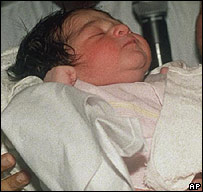
Two recent reports have come out of India related to children’s issues and intervention: one report deals with the ongoing problem of Indian girls, and the other report details widespread lack of nourishment among Indian children. These reports give a bit more context to the resistance that caregivers face in providing care to these at risk children. The same cultural dynamics that place Indian children at risk also resist the care options for these children, especially girls…
A cry of girls at risk
The first article is somewhat hopeful, as India's central government tacitly acknowledges a deep problem. It plans a serious of “cradle orphanages,” where unwanted baby girls can be raised – hoping to stem the tide of widespread female feticide. Research shows that more than 10 million Indian girls have been killed in the last two decades, via abortion and infanticide.
Renuka Chowdhury, the minister of state for women and child development, has taken this issue to heart. She notes that female feticide is producing an alarming imbalance between males and females, and hopes to offer a solution. Thankfully, Renuka is outspoken on this issue, and we can only pray for others to follow her lead.
The last line in the Detroit News article states the underlying issue: destruction of girls “stems from the low value attached to females in Indian society.”
It is a deadly serious issue. India’s Hindu culture struggles with the results of its own prejudice, and now faces a painful truth: Any society that devalues its girls devalues itself.
A story of malnourished children
A second article details figures from India's National Family Health Survey, showing that nearly half of India’s children are malnourished. This puts India, now the most populous country, ‘in the same league as some of the world’s poorest countries.’
India has made dramatic strides on the world stage, enjoying a technological and economic boom – and yet these economic gains are not being matched by ‘equal improvements in the health of its more than one billion people.’
This is staggering to think about, really – that a country with more than one billion people exists with half of its children malnourished. The numbers are numbing.
Werner Schultink of UNICEF concludes that India should be worried: “It’s going to be difficult for India if it wants to use its human resources to develop the nation but does not make [human] improvements.”
A chance to make a difference
Behind both of these reports lurks an underlying societal brokenness – the war on India’s children, its girls and outcastes, is a war that starts in the mind and works its way into the streets – a terrible reality.
It’s interesting that the people invested in assisting orphans and unwanted Indian children are often the same people rejected by traditional Hindu power brokers. In light of India's great orphan need, consider how Hopegivers orphanages have been treated this last year! Consider how Sam Thomas and other caregivers have been attacked, their lives threatened and ruined for trying to help the same children that others do not want! The children unfed, unclothed and outcaste, the girls devalued and thrown away… these poor girls are offered care, and yet those who give them care are viciously attacked by entrenched Hindutva leaders!
Herein is the crux of the problem. I pray that Renuka Chowdhury and the other appointed ministers of India will not overlook systemic issues, and not overlook the amazing resources already in place for helping these girls. Already there are orphanages in place, places of education and care, staffed with loving, sacrificial people… if only these orphanages could be protected from the onslaughts of entrenched traditional militants!
Here also is a path for us to help. We can do something, by supporting Hopegivers orphanages – places of light and hope for India’s children…
The sacrifices of Dr. Sam and M.A. Thomas, and the intrepid caregivers of Emmanuel Hope Home, and others in India, are not in vain.
And our gifts are not in vain, providing moments of light and salvation! Please give something today, if you can... God bless your heart and actions!
Selah.

Showing posts with label female feticide. Show all posts
Monday, February 19, 2007
Saturday, December 23, 2006
India’s endangered species: girls
Indian female feticide: 10 million killed in 2 decades
According to a UNICEF report released this month, 7,000 fewer girls are born in India every day than the global average would suggest. This is attributed to both abortion after ultrasound tests and also the killing of newborns.
Renuka Chowdhury, Minister for Women and Child Development, says that in India, 10 million girls have been killed by their parents in the past 20 years, either before they were born or immediately after. She aptly calls it a “national crisis.”
"Today, we have the odd distinction of having lost 10 million girl children in the past 20 years," Chowdhury told a seminar in Delhi University.
"Who has killed these girl children? Their own parents."
In traditional Hindu practice, girls are often viewed as liabilities: they are tools in trade, property to be bartered – not only in the lingering practice of dowry, where the bride’s parents pay for the groom to marry her, but also in the continuation of a kind of emotional suttee, where the wives only have rights as their men choose to give them.
Scratch the surface of Indian society, and you’ll find powerful social prejudice, to the point of female devaluation. And now, that devaluation is seen in the destruction of unborn and newly born girls: as technology increases, so does selective killing… inordinately biased against girls.
"Even today when you go to a temple, you are blessed with 'May you have many sons.'"
Female feticide worst in places of militant Hinduism
Perhaps not surprisingly, the incidence of female feticide rises in the places where traditional Hinduism is practiced militantly. For instance, in the western desert state of Rajasthan, where militant Hinduism controls much of the political and police infrastructure, newborn girls are often killed by pouring sand or tobacco juice into their nostrils.
"The minute the child is born and she opens her mouth to cry, they put sand into her mouth and her nostrils so she chokes and dies…
"They bury infants into pots alive and bury the pots. They put tobacco into her mouth. They hang them upside down like a bunch of flowers to dry…
"We have more passion for tigers of this country. We have people fighting for stray dogs on the road. But you have a whole society that ruthlessly hunts down girl children."
Is it any surprise that this state of Rajasthan is also the place where orphan caregivers have been terrorized and tortured, this last year? Some people are very invested in making sure that young girls don’t get a chance, that outcast children remain outcast – locked into their sordid place.
Female feticide not a matter of education, but ideology
Also, interestingly, in India, the incidence of female feticide also rises in relation to education and social class. Chowdhury says that the practice of killing baby girls is ‘more prevalent among the educated, including in upmarket districts of New Delhi, making it more challenging for the government.’
"How do we tell educated people that you must not do it? And these are people who would visit all the female deities and pray for strength but don't hesitate to kill a girl child…”
One can sense the frustration in her voice: the very ones who supposedly wouldn’t do such a thing – educated classes – are the ones who practice it most. Underlying her words is the rampant drumbeat of a lingering caste system, and all its ideological devastations.
In other words, the India that Amy Carmichael discovered, where young Indian girls are most at risk, where beautiful girls are devalued and sold before the altar of Shiva, that India still makes itself known – to the tune of 10 million dead girls in 20 years, and countless other millions broken into little inner pieces, trapped in physical and spiritual slavery.
And, when caregivers offer integral intervention to these outcast girls, they soon find that they only risk their own lives and reputations: in many places, it isn’t safe to rescue girls from social destruction. Just ask Sam Thomas and the Hopegivers caregivers, who’ve been persecuted, imprisoned and terrorized this last year, in Rajasthan!
The place to counter female feticide…
The place to counter this female feticide is in the heart – to change the heart, to offer a new vision to the mind. In practical terms, this means supporting those who are making a difference – those who actually rescue these girls and tell them that their life has infinite meaning!
In other words, there is an inward and outward demand that this feticide places upon us: it begins in our hearts, we who say we care, and then flows to the point places of need. It begins as we look in the mirror and say, “Who, me?” and then answer by saying, “Yes, I too bear the blame.” And then, giving and living to make a difference: give to people like Hopegivers, who exist to meet this need, among others. And, then live like we really care about feticide: it’s pure spiritual foolishness to act as if we are against female feticide in India, and then voting to support abortion here in the USA. It’s like the lady who said she supported missions in Africa but wouldn’t let a black man pray in her church – the same human idolatry underlies both feticide and abortion…
Look in the eyes of these girls, and ask if they deserve a chance at equal life. Ask if they are worth the world – and consider how many lights like theirs have been darkened!

And as you ponder this, consider a gift to Hopegivers, this Christmas! As one said long ago, “The light shines in the darkness, and the darkness has not overcome it!”
In your gift, in your life, in truth, the light goes on, still!
Merry Christmas as you make a difference this year, here!
Selah.
Labels:
abortion,
female feticide,
Hopegivers,
India
Sunday, August 20, 2006
India's lost girls

India's endangered species: baby girls
The brides never had a chance to be born
In Punjab, special prayers of thanks greet the birth of a boy… Girls are born into silence.
"People say, you have two girl children, you have done some sins in your past life…" Surinder Saini.
Recent research into India’s abortion by sex selection estimates that India has experienced a net loss of 10 million baby girls over the last two decades. This is stunning. Certain groups dispute the figure. But what is not disputable is the unusual gender balance in India. Estimated research is disputable, but empirical numbers are not.
Demographic studies across India show that, on average, there are around 900 girls for every 1,000 boys. In some provinces this figure dips below 800 for the girls, and sinking. Multiply this figure times the national number and the result is staggering.
Female devaluation not devastates girls, it hurts an entire society.
Jill McGivering aptly notes:
All those years of prejudice against girls are finally coming back to haunt this society.
There is such an acute gender imbalance here that it is causing real social problems. Young men are coming of marriageable age, only to discover there is no one left for them to marry.
The young girls who would have been their brides never had the chance to be born…
In Haryana, a quarter of the female population has simply disappeared.
Inquiry into Rajasthan female feticides
Police in the Indian state of Rajasthan have launched an investigation into 21 doctors who are alleged to have been involved in aborting female fetuses. But those persons truly invested in saving female lives say that this “police investigation” is just a smokescreen to cover up the real problem. They have no faith in the police or state politic on this issue, instead pleading for the Central Bureau of Investigation to take up the cause.
"The police case is just an eye wash to delay the investigation. We don't have faith in the state agency. We want the CBI to investigate the scandal," Kavita Srivastva of the People's Union for Civil Liberties (PUCL) said.
According to the last census, Rajasthan has 922 females per 1,000 males. However, some districts have an even more dismal sex ratio.
Gory tale of Punjab's lost girls
In Punjab, the government is investigating the “possible involvement” of state officials in setting up illegal clinics and ultrasound centers dedicated to female feticide.
Last week, a surprise raid by police and health officials unearthed a 30-foot well located behind a private clinic, which contained the remains of female fetuses.
The discovery provoked the ‘largest ever campaign against female feticide’ across the state's 23 districts; yet Virender Singh Mohi, the official who led the raid against the hospital, has received several phone calls with death threats – threatening to kill him if he continues the raids on private hospitals. In response, Mr. Mohi notes the obvious:
"There are very strong and influential vested interests in keeping this illegal practice going...”
Darshan Kumar Singla, a local journalist in Patran, says that although everyone is aware that female feticide is illegal, most people do not think anything about aborting a female child and trying again for a boy.
"Female feticide is rampant in all the small towns here. Most nursing homes do such work at night and everybody – the police, the health authorities and the civil administration – knows this is happening.
He says that people are sitting up and taking notice only because the fetuses in the well became too public to ignore, that the problem is so widespread and ingrained that laws cannot stop the practice – it only creates a booming black market.
The implication is that only a change in heart, a change in culture, will end the destruction. The system of dowry – and attendant ingrained devaluation of girls – feeds into deep greed in the parents’ hearts. It is common practice for parents to abort girls and try again for boys – even among those who otherwise might be against the practice of female feticide [in theory].
Pritam Singh, the owner of Sahib Hospital who is under arrest, says, "The only thing that could really end this problem is a firm end to the system of dowry.”
Praying for a cultural change of heart
But, of course, ending dowry would mean a change in the hearts and minds of traditional Indian people. The India that Amy Carmichael found a few decades ago, where girls were devalued and fed into the crucible of ritual Hindu temple prostitution, lurks just beneath the surface of this debate.
When someone tries to make a difference, s/he is threatened with loss of life or vocation. Just ask Sam Thomas and the Hopegivers orphanage in Rajasthan, where they’ve faced an incessant tide of threats, beatings, persecution, imprisonment, and illegal law manipulation in their effort to reach outcast girls and boys. Just ask the girl orphans of Emmanuel Hope Home who’ve faced attempted rape by Hindu authorities in Kota, Rajasthan.
The issue is serious and heartbreaking, and goes to the soul of Indian culture as surely as the practice of American abortion goes to the soul of our culture: the place where truth is exchanged for lies and innocents pay the price on the altar of human greed.
And here is where a devastating Indian practice reaches across the oceans and continents, and runs down the line of good and evil that pierces our own hearts.
We cannot truly stand for innocent Indian girls without also standing against something in our own cultural soul…
Selah.
Labels:
abortion,
female feticide,
Hopegivers,
India,
orphans