Showing posts with label war. Show all posts

Friday, January 23, 2009

Dalai Lama: Non-violence cannot answer terror

A stunning admission

This week, the Dalai Lama frankly admitted that the principle of ahimsa [or non-violence] cannot be properly applied to terrorism. Prevention is the only way to handle terror, he said.

NEW DELHI: The Dalai Lama, a lifelong champion of non-violence on Saturday candidly stated that terrorism cannot be tackled by applying the principle of ahimsa because the minds of terrorists are closed.

"It is difficult to deal with terrorism through non-violence," the Tibetan spiritual leader said delivering the Madhavrao Scindia Memorial Lecture here.

He also termed terrorism as the worst kind of violence which is not carried by a few mad people but by those who are very brilliant and educated.

"They (terrorists) are very brilliant and educated... but a strong ill feeling is bred in them. Their minds are closed," the Dalai Lama said.

He said that the only way to tackle terrorism is through prevention. The head of the Tibetan government-in-exile left the audience stunned when he said "I love President George W Bush." He went on to add how he and the US President instantly struck a chord in their first meeting unlike politicians who take a while to develop close ties.


This surprised a lot of people, but it is very wise counsel that recognizes the nature of terrorism as well as the true nature of peace. It also begs the question: if the Dalai Lama, whose entire life is predicated on peace, fully recognizes the limits of peace in reference to terror and strongly appreciates the attempts of President Bush to deal with world terror, then why has Bush been so despised by those who use peace as their pretext of dislike?

The answer lies in metaphysics, of course. And, to lesser degree, politics.

Interesting, no?

The pretext of peace

Several powerful lessons in this presentation of the Dalai Lama:

  1. Education is not the answer to terrorism. It's only the well educated who are allowing terror to continue in our world, not the unwashed masses of popular thought.
  2. Non-violence is not the answer to terrorism [i.e. the limits of peace and the destructive nature of pseudo-peace].
  3. President Bush was right in his general approach to terror.

These are ground-shaking claims for some people. But the logic is intense and accurate. Leaving aside claim three [which follows from claims one and two], it's easy to see that the Lama well understands the limits of education. The lesson also speaks to the limits of non-violence, the potentially counterproductive nature of peace claims. Here the Dalai Lama is very consistent with the teaching of the Hebrew prophets: they showed that peace claim can [and will] be used to destroy God's people. The Apostles later followed this out, revealing that the Antichrist comes as a man of peace -- and the spirit of Antichrist gains its power on peace claim.

Mere education does not change the heart. And it is the heart that decides the issues of life. It is the heart that causes many who currently use the word peace to make common cause with modern terror.

Selah.

Wednesday, January 24, 2007

How can a person be both pro-life and pro-war?

Learning from my mother on abortion and war

My mother marched in Washington on Monday, in defense of unborn children. Her take was remarkable, especially the part where she heard newly elected Pennsylvania Senator Bob Casey, Jr. and Sen. Arlen Specter field questions from a pro-life constituency. Those who consider Casey pro-life would have been well-served to sit in on this session. Not for nothing has Chuck Schumer boasted that Casey will be firmly on board with the pro-choice voting line, when significant votes arrive...

But I digress. My mother’s quiet courage to attend this march alone – traveling without knowing anyone on the bus – in order to lift her voice against the night, this courage has moved me deeply! And so I take up my pen tonight to do some heavy lifting in this battle for life…

I’m thinking specifically of a question asked by a friend, concerning the seeming hypocrisy of people who march for life and yet support war. Perhaps you’ve heard it, but the question goes something like this:

Q: How can person be pro-life and yet supportive of war? Isn’t this terribly hypocritical?

A variation of this question substitutes capital punishment for war, but the implication is the same: if a person is for life, s/he is a hypocrite to support something that engenders any death [e.g. war or capital punishment]. The unspoken part of this argument is that a person is morally justified in voting to enable abortion if someone else is justified in voting to enable war – abortion is reduced to just another political position.

That is a regretful stance – doubly regretful because it misunderstands both life and war while enabling war on life.

When life and war are understood in a revelation framework, it presents a powerful answer to the question of pro-life hypocrisy.

Biblical definition of life: creation and existence in the Image of God.
Biblical definition of war: use of force to restrain evil.


Abstract: If human life is defined in relation to divine nature and intent, the Imago Dei, then it’s consistent to oppose abortion while supporting just war [theoretically], because in each position, the person is defending the Imago Dei against evil: the evil that would destroy life before its fruition, and the evil that would destroy life in its function.

If the argument is made that war in itself is evil, therefore cannot be properly used to combat evil, then I would reply: One should not confuse means with actuality, especially in understanding evil. An axe in the hands of a woodsman is life-sustaining; an axe in the hands of Freddy Krueger is a nightmare.

Yet the question necessarily reflects on a divine level: Is it possible for a good, life-giving God to be for war?

After all, we claim that God is perfectly good, our good “Father of lights, with whom is no variation or shadow of turning,” the One who “cannot be tempted with evil, neither tempteth He any person.” God is for life, unequivocally so: God has given His one and only Son that we might have life, and have it more abundantly. Can this good God – unalterably good and equivocally for life [in its highest definition] – be for war?

The answer is conceptual [rather than categorical, key distinction] but it is again, unequivocal. War first began in the heavenly plane: Force was first used when evil [and all its dark mystery] acted against Imago Dei on a non-earthly plane.

And there was war in heaven: Michael and his angels fought against the dragon; and the dragon fought and his angels, and prevailed not; neither was their place found any more in heaven. And the great dragon was cast out, that old serpent, called the Devil, and Satan, which deceives the whole world: he was cast out into the earth, and his angels were cast out with him. [Revelation 12:7-9]


The view of revelation is that war preceded the human plane, and that war was used by God to cordon the spread of evil. Scripture presents the paradox of a Holy God who is consistently for life and for peace while being an active Warrior: the Christ who says, ‘Those who live by the sword will die by the sword’ is shown at the end of time, riding a white horse with a flaming sword…

And I saw heaven opened, and behold a white horse; and he that sat upon him was called Faithful and True, and in righteousness he doth judge and make war. His eyes were as a flame of fire, and on his head were many crowns... [Revelation 19:11]

For the mystery of lawlessness is already at work… And then the lawless one will be revealed, whom the Lord will slay with the breath of His mouth and destroy with the brightness of His coming. [2 Thessalonians 2:7-8]


Likewise, the prophet Isaiah saw this Christ as the strong Warrior coming back from Bozrah, with His robes dipped in blood:


Who is this coming from Edom, from Bozrah, with His garments stained crimson? Who is this, robed in splendor, striding forward in the greatness of His strength?

“It is I, speaking in righteousness, mighty to save.”

Why are your garments red, like those of one treading the winepress?


“I have trodden the winepress alone; from the nations no one was with me. I trampled them in my anger and trod them down in my wrath; their blood spattered my garments, and I stained all my clothing.

“For the day of vengeance was in my heart, and the year of my redemption has come. I looked, but there was no one to help, I was appalled that no one gave support; so my own arm worked salvation for me, and my own wrath sustained me.

“I trampled the nations in my anger; in my wrath I made them drunk and poured their blood on the ground.” [Isaiah 63:1-6]


In reading these texts there is a mystery, and it is the mystery of justice, the mystery of righteousness: How can Goodness use a sword to defend life? How does the One who calls himself Life own the blood of His enemies?

How can this be?

Key: the divine Warrior only takes the sword to defend creation intent against the onslaughts of the night. The Holy One makes war when war would consume the Imago Dei in His people…

Consistently, this concept is applied from divine to human planes, where the State is properly viewed as a servant of God to contain evil:

For rulers are not a terror to good works, but to evil. Do you want to be unafraid of the authority? Do what is good, and you will have praise from the same. For he is God's minister to you for good. But if you do evil, be afraid; for he does not bear the sword in vain; for he is God's minister, an avenger to execute wrath on him who practices evil. [Romans 13:3-4]


The proper role of State: God’s minister to protect good and execute wrath on the practice of evil.

Here we begin to see the coalescing of revelation, in relation to abortion and war: Life in the image of God is seen as something worth fighting for, something worth defending. Innocent life is not equal with guilty life: Adult humans destroy themselves from the Imago Dei when they turn their will against divine intent and partner with evil.

And, as Thomas Aquinas clearly expressed, when God punishes evil, that punishment of evil is not an evil, but a good: Punishment is a function of the good to which evils are attached, not a function of prior divine imperative. God cannot will the sinner to evil, since this is a “privation of right order towards the divine good.” God can will a context in which the sinner chooses evil, but this is only because God has first willed the attendant good. The sinner wills evil, and God wills punishment, or justice, which is a good.

Likewise, God wills no one to perish, but those who destroy Imago Dei must perish, because they destroy their own life: God is life and only in God can there be life.

Those who oppose the killing of unborn children and support the just killing of evil men [war] are actually intuiting the divine order of Imago Dei. In both directions they act to defend life: life in its promised fruition and life in its existent function.

And thus is exposed the lie of pacifism: pacifism demands a moral equivalency of physical life without referent to innocence, or to divine Image. The consistent pacifist will stand by while his wife and children are raped and killed, because he equates the life of the terrorist with the life of his family. I once posed the question to an intellectual grad student who paraded his pacifism at a party: “Would you stand by while your wife and children were harmed by an intruder?” He answered, “I would hope I would be true to my principles.” My reply: such a person may be true to his principles, but he wouldn’t be true to God, or to his family.

Thankfully, God suffers under so such ‘principles.’ He ‘has no pleasure in the death of the wicked,’ but He often demands such death in the restraining of evil.

We are human actors in a cosmic war, and we reveal our proper relation to God as we defend the Imago Dei in the life of the unborn and in the life of those grown children being killed by evil men.

This answer is more than logically consistent: it is relationally consistent with divine decree.

Someone as humble as my dear mother, who cannot stand violence in any form, knows the truth of divine Person as she marches for unborn children in Washington, D.C., and, in the same breath, hopes for human freedom world over, though such freedom demand war…

This is not to say that all war is right, but rather to say that she is not a hypocrite in her stance. She is a child of God, striving for understanding in the Spirit of Truth. She is for unborn children, and she is for war, if it be that war might defend grown children against the destruction of Imago Dei.

Thanks, Mom, for marching this week! May your march of courage inspire those souls seeking courage, yet not yet sure of the path!

Selah.

Sunday, August 27, 2006

Choosing this day to be a stone of glory


At the centre of the universe


C. S. Lewis


His journey to Perelandra was not a moral exercise, nor a sham fight. If the issue lay in Maleldil's hands, Ransom and the Lady were those hands. The fate of a world really depended on how they behaved in the next few hours. ...

The voluble self protested, wildly, swiftly, like the propeller of a ship racing when it is out of the water. The imprudence, the unfairness, the absurdity of it! Did Maleldil want to lose worlds? What was the sense of so arranging things that anything really important should finally and absolutely depend on such a man of straw as himself? And at that moment, far away on Earth, as he now could not help remembering, men were at war, and white-faced subalterns and freckled corporals who had but lately begun to shave, stood in horrible gaps or crawled forward in deadly darkness, awaking, like him, to the preposterous truth that all really depended on their actions; and far away in time, Horatious stood on the bridge, and Constantine settled in his mind whether he would or would not embrace the new religion, and Eve herself stood looking upon the forbidden fruit and the Heaven of Heavens waited for her decision. He writhed and ground his teeth, but could not help seeing. Thus and not otherwise, the world was made. Either something or nothing must depend on individual choices. And if something, who could set bounds to it? A stone may determine the course of a river. He was that stone at this horrible moment which had become the centre of the whole universe...

C. S. Lewis, Perelandra

Wednesday, August 09, 2006

Would you recognize Hitler...

...if he came in your generation?

A question runs through my mind: How can we claim to be on the side of light in reference to past crimes, if we cannot delineate between good and evil on this day, this very day?

Look at this video, where a modern leader leads the masses in mesmerizing chants: Death to Israel! Death to America!

Look at this video, where a passionate speaker sways the minds of his followers with a revised history and call for blood.

Look at these videos and ask, "Was it any clearer during Hitler's time -- this call for Jewish destruction?" Or was it even muddier then, with the Holocaust denied until the camps were discovered by the Allies? Indeed, morality is easy in hindsight, and these calls for Jewish destruction are far clearer than Hitler's... or Stalin's... in the death of tens of millions of Jews.

We will not be judged for another time. Neither will easy moralisms against evil in another time absolve us from the guilt of our own time. We will be judged for today, for where we stood when darkness offered the price in our own terms.

Look at these videos, and evaluate where you stand!

Selah.

Sad update: Meanwhile, Mike Wallace of CBS News calls Ahmadinegad smart, interesting and charming...at the same time referring to Israel as "that Zionist state." Unbelievable, yet real. Thus is evil enabled in our time. Hitler and Stalin had their charms, as does every mass murderer. Antichrist comes as a man of peace. Now we see just how such destroyers are feted, how they are excused: good called evil and evil good, on the basis of banalities, while millions of Jews, Christians and innocents die.

Tuesday, July 25, 2006

More words from a reluctant war


Smoke billows from a terrorist stronghold in southern Lebanon

Hezbollah took us hostage


Hezbollah didn’t only take 2 Israeli soldiers hostages, but he took Lebanon hostage and gave it to its masters (Iran & Syria) as a bargaining chip. Do we Lebanese have a saying in all this? Did Hassan Nasrallah ask us, the Lebanese, if we agreed on such operation? He doesn’t care. He thinks he is untouchable and any decision he makes, we the Lebanese, must obey it. After all he is a Muslim religious leader and Allah path is the right one. He threatened every single Lebanese, right after kidnapping the Israeli soldiers, he asked all Lebanese to stand by his resistance or else. Or else, what? You will pull your Imam Ali sward and cut our heads?

Mano, writing on the Ouwet Front, a Lebanese Forces blog.

What the Lebanese think of Hezbollah


I think all the Arab flag wavers need to find someone Lebanese to speak to. Not Syrians with Lebanese passports, and not Shiaas either. Find yourself a Sunni Lebanese, a Christian, Durzi or Marouni. Talk to them. Ask them about what they think of Hezb ‘ollah…

Guess what? Not a moment goes by without them cussing at Hezb ‘ollah. And they too believe that Hezb ‘ollah is armed to the gills with Syrian and Iranian weaponry. Even the Syrians I spoke to admit that Syria supports Hezb ‘ollah with material.

So it irks me when I read that Egyptians - the politically immature mixed in with the blindly nationalistic Nasserites for example - cheer on Hezb ‘ollah like they have a vested interest in the continuation of this lunacy. Sorry, but you aren’t even Lebanese! It’s easy for us Arabs to support an organisation that wrecks havoc against our ‘enemy’ but does it on someone else’s expense.

I mean, if Hezb ‘ollah decided to open shop in Sinai, and fight Israel from across our border, how many Egyptians would cheer then? Even if it meant having to contend with parts of Cairo being shelled back to the stone age, literally? I highly doubt it…


Mindbleed, Arab blogger writing “to Arab brothers” [Warning: Language alert on this site].

How the U.N. legitimizes terrorists


Part of the goal of organizations like Hezbollah and Hamas is to gain moral legitimacy for their terrorist tactics by having them equated with the conventional military tactics used by democratic regimes. Only the morally obtuse--or perverse--cannot recognize the difference between a terrorist group that targets civilian population centers with anti-personnel weapons designed to maximize civilian casualties and a democracy that seeks to prevent terrorism by employing smart bombs designed to minimize civilian casualties.

Annan knows better than to suggest a moral equivalence. He is fully aware of the tactic employed by terrorists of launching their rockets from, and hiding behind, civilian shields, so as to make democracies have to kill some civilians to get at the terrorists.

But Annan heads an organization that is so anti-Israel that as the late Abba Eban, the early Israeli ambassador to the UN, once put it: "If Algeria proposed a resolution that the Earth was flat and that Israel has flattened it, it would pass by a vote of 120 to 3, with 27 abstentions."

Many such resolutions have been passed by the General Assembly, including the notorious one equating the Jewish national liberation movement with "racism." Other one-sided resolutions have been passed by the General Assembly legitimating terrorism. Only the U.S. veto--which does not operate in the UN General Assembly--has prevented one-sided resolutions by the Security Council.

If a space alien from a distant planet were to land at the UN, he would come away with the impression that Israel is not only the sole offender in the Middle East, but the worst offender in the entire world. He would single out Israel for condemnation and exclude it from membership on many UN bodies, on which Syria, Lebanon and Iran serve in positions of honor.

Annan himself has a long history of one-sided condemnations of Israel. In March 2004, Annan "strongly condemned" Israel's targeted killing of Sheik Ahmad Yassin, the terrorist leader of Hamas, without condemning Yassin for his murderous actions or his organization for the murder of Jewish civilians. In December 2003, Annan "strongly condemned" Israel's assault on a Palestinian refugee camp where two gunmen were thought to be hiding. And in 2005, he issued the most tepid of statements--expressing "dismay"--at threats by Iran's president to "eliminate" Israel, a member nation of the UN. The list goes on and on.

And even worse than the one-sided condemnations that ignore Hezbollah and Hamas are the numerous statements that perversely suggest moral equivalence.

The UN peacekeepers on the Lebanese border have turned out to be collaborators with Hezbollah, videotaping the Hezbollah kidnapping of three Israeli soldiers in 2000 and then refusing to release the video--which could have helped in the rescue--on the grounds that it might compromise their "neutrality."

This is a real test for the UN. If it cannot--or will not--distinguish between terrorists who target civilians and a democracy that seeks to stop the terrorism while minimizing civilian casualties, it has become part of the problem, rather than part of the solution.


Alan Dershowitz, describing how the U.N. legitimizes terrorists.


A pictorial of anti-Semitism

Before arriving in South Florida this weekend, I had heard from several friends in the area that the Miami Herald was providing slanted coverage of the war in the Middle East. I had visited the web site, but that was largely a collection of wire stories.

Then I saw Saturday’s paper. The most prominent headline on the front page, in the center, above-the-fold, was “The human cost of war.” Immediately below was surprisingly brazen bias. Before I describe more, look for yourself…

Joel Mowbray showing one example in a long line of brazen mainstream media bias against Israel.


“Proportional” -- new anti-Semitic code word


If by chance you have the search engine LexisNexis and you punch in the words "Israel'' and "disproportionate,'' you run the risk of blowing up your computer or darkening your entire neighborhood. Just limiting the search to newspapers and magazines of the last week will turn up "more than 1,000 documents.'' Israel may be the land of milk and honey but it certainly seems to be the land of disproportionate military response -- and a good thing, too.

The list of those who have accused Israel of not being in harmony with its enemies is long and, alas, distinguished. It includes, of course, the United Nations and its secretary general, Kofi Annan. It also includes a whole bunch of European newspapers whose editorial pages call for Israel to respond, it seems, with only one missile for every one tossed its way. Such neat proportion is a recipe for doom.

The dire consequences of proportionality are so clear that it makes you wonder if it is a fig leaf for anti-Israel sentiment in general…

Readers of my recent column on the Middle East can accuse me of many things, but not a lack of realism. I know Israel's imperfections, but I also exult and admire its achievements. Lacking religious conviction, I fear for its future and note the ominous spread of European-style anti-Semitism throughout the Muslim world -- and its boomerang return to Europe as a mindless form of anti-Zionism. Israel is, as I have often said, unfortunately located, gentrifying a pretty bad neighborhood. But the world is full of dislocated peoples and we ourselves live in a country where the Indians were pushed out of the way so that -- oh, what irony! -- the owners of slaves could spread liberty and democracy from sea to shining sea. As for Europe, who today cries for the Greeks of Anatolia or the Germans of Bohemia?

These calls for proportionality rankle. They fall on my ears not as genteel expressions of fairness, some ditsy Marquess of Queensberry idea of war, but as ugly sentiments pregnant with antipathy toward the only state in the Middle East that is a democracy. After the Holocaust, after 1,000 years of mayhem and murder, the only proportionality that counts is zero for zero. If Israel's enemies want that, they can have it in a moment.

Richard Cohen, telling us why “a ‘proportional response’ is madness.”


The inhumane nature of an immature ceasefire


We know that the missile that wrecked an IDF warship and killed four sailors on July 15 was manufactured in Iran to a Chinese design. We know that Hezbollah's longer-range weapons are commanded by Iranian Revolutionary Guards. We know that Hezbollah's fighting forces were equipped and trained by Iranian officers. And we know above all that Hezbollah is financed, equipped, and trained by the Iranian secret service. It carries out terror missions on behalf of Iran. For all practical purposes, Hezbollah is an arm of the Iranian state.

And when Hezbollah goaded Israel into war, the war it triggered was not a war between Israel and Lebanon.

The war Hezbollah provoked is a war between Israel and Iran, with Hezbollah as Iran's proxy--and the people of Lebanon as Iran's victims. The Lebanese have been kidnapped by Iran as surely as those two Israeli soldiers abducted on the northern border.

Israel has recognized that tragic fact. It has fought this war on its northern border as humanely as it can. Flip the switch in Beirut and the lights come on; open the taps, and the water flows. Essential services have been spared. The runways at Beirut Airport have been bombed to stop reinforcements to Hezbollah, but the control towers and the newly built terminal have been spared because Lebanon will need them later.

Unintended civilian casualties have tragically occurred, as they do in any war. But Israel's sincere and costly attempts to minimize the loss of innocent life present a stark contrast with Hezbollah's deliberately atrocious war methods.

Hezbollah has boasted that it has tried to fire missiles into Haifa's chemical factories, in hope of releasing gases to poison the civilian population. Hezbollah rocket warheads arrive crammed with ball bearings, so as to inflict maximum death and suffering upon the civilian populations at which they are fired.

Nobody wants the war to last a minute longer than it needs to. But ironically, letting this war go to the finish would be a far more humane policy than the UN's call for an immediate, unconditional ceasefire.

Thoughts from David From, resident fellow at AEI.

Thursday, July 20, 2006

A collection of words from a reluctant war


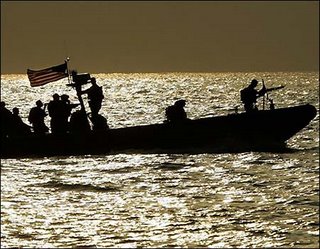
U.S. Marines on a rigid, inflatable hull boat patrol the coast of Lebanon, guarding the security of fleeing Americans. [Foxnews photo-essay]

A reluctant conflict


“We – the majority of us anyway – don't want peace with Israel, and are not interested in any real dialogue with them. We weren't then and we are not now. The entire peace process has always been about getting the land back, not establishing better relations. Even when we do get the land back, it's not enough. People in Egypt lament daily the Camp David treaty that prevents us from fighting. In Gaza they never stopped trying to attack Israel. In Lebanon Hezbollah continued attacking even after the Israeli withdrawal. And the people – the majority of the Arab population – support it. Very few of us are really interested in having any lasting Peace or co-existence. I mean, if our left is asking for war, what do you think the rest of the population is thinking?

I think that the Israeli want peace with us because they don't want their lives disrupted. They don't want to have the IDF soldiers fighting in Gaza, rockets coming into their towns from Hamas or having to go to wars against Hezbollah to get their soldiers back. I think they want peace because they want their peace of mind. They view us as if we were a headache. We view them as if they are a cancer.

And this is why there will never really be any peace in the middle-east."

Candid words from Egyptian blogger “Sandmonkey,” speaking in collective voice regarding positions he himself does not hold.


“While the people of Palestine and Lebanon are paying the price of this bloody conflict, the main players, who caused this conflict, are living in peace and asking for more oil from Arab countries to support the facade of resisting Israel. With the Palestinian Authority close to collapse and the Lebanese government beginning to give up responsibility for what is happening in its territory, Saudi Arabia has been forced to come out of its diplomatic routine and indirectly hold Hezbollah responsible for what is happening Lebanon…

Unfortunately we must admit that in such a war the only way to get rid of 'these irregular phenomena' is what Israel is doing. The operations of Israel in Gaza and Lebanon are in the interest of people of Arab countries and the international community."

Incisive thoughts from Ahmed al-Jarallah, editor of the Arab Times, a Kuwaiti based paper that publishes online, quoted by New York Daily News.


Most Arabs perceive Israel as small. Egypt – home to one of every three Arabs – has enjoyed a cold peace with Israel for more than a quarter-century. Gulf states, on the whole, would rather make money than directly fight Israel. While they do not like Israel's existence, Jerusalem presents no threat. Not so Tehran. A giant with 70 million people, Iran is no status quo power. Its ideological commitment to export revolution is real. Across Lebanon and the region, Arab leaders see Hezbollah for what it is: An arm of Iranian influence waging a sectarian battle in the heart of the Middle East.

Some words of Michael Rubin, a resident scholar at AEI.


For years, the Arab world clamored for the Israel "problem" to be solved. Then peace and security would at last supposedly reshape the Middle East. The Western nations understood the "problem" as being Israeli retention of lands it had captured in Sinai, the West Bank, Gaza, Syria and Lebanon after defeating a series of Arab forces bent on destroying the Jewish state.

But after the Israeli departure from Sinai, Gaza and Lebanon, and billions of dollars in American aid to Egypt, Jordan and the Palestinians, there is still not much progress toward peace. Past Israeli magnanimity was seen as weakness. Now Israel's reasoned diplomacy has earned it another round of kidnapping, ransom and rocket attacks.

Finally, the world is accepting that the Middle East problem was never about so-called occupied land -- but only about the existence of Israel itself. Hezbollah and Hamas, and those in their midst who tolerate them (or vote for them), didn't so much want Israel out of Lebanon and Gaza as pushed into the Mediterranean altogether. And since there will be no second Holocaust, the Israelis may well soon transform a perennial terrorist war that they can't easily win into a conventional aerial one against a terrorist-sponsoring Syria that they can.

Victor Davis Hanson, revealing that "Western patience is wearing thin."


From Israel's perspective, defeating this unconventional enemy requires an unconventional strategy. Hizbollah's headquarters are in urban neighborhoods and it fires its rockets from civilian areas, making it virtually impossible for Israel to distinguish between combatants and non-combatants. Israel's response is to destroy those elements of Lebanon's infrastructure, including its civilian components, which it says house and sustain Hizbollah.

Israel is using the "opportunity" presented by Hizbollah's attack to take care of the guerrilla force once and for all. But given Israel's choice of methods, it is inevitable that innocent Lebanese civilians will be killed in the process...

World attention is focused, legitimately, on the level of destruction being meted out on Lebanon. But in assessing Israel's response, one needs to look beyond the asymmetry of power, to a second asymmetry in terms of goals. Israel's goals are strategic, while Hizbollah's are existential. Israel has the greater arsenal, but it is fighting an enemy that won't be satisfied as long as Israel continues to exist. In this case the asymmetry is reversed. And it begs the question: how should you fight such a group as it wages war on you?

Hizbollah is not just a "Lebanese militia," but is Iran's proxy army, with Syria as the middleman. Hizbollah's actions, and Israeli reactions, could spark a regional war. "I'm afraid that if the Iranian president allows Hizbollah to use its long distance missiles against Israel" and they hit Tel Aviv, says Cheshin, "very soon we will find ourselves in a third world war."

The Lebanese people are being squeezed between Israel and Hizbollah, two forces that do not prioritize protecting Lebanese life. But so long as Lebanon and the international community remain unable or unwilling to disarm Hizbollah and remove it from Israel's border, Israel will continue to use its arsenal in a "deliberately disproportionate" manner against the organization that proudly declares itself to be Israel's existential enemy.

It is time for the international community to step into the fray for the sake of the Lebanese and the Israeli people. But any serious proposal must acknowledge that there can be no return to the "status quo ante."

Some thoughts from Pierre M. Atlas, assistant professor of political science and director of the Franciscan Center for Global Studies at Marian College.


Wednesday, July 19, 2006

The deadly racism of demanding Jewish restraint


Birkenau. The tracks which Ahmadinejad denies lead to the ovens which Ahmadinejad denies. But surely this all happened because of Jewish lack of restraint!

A true story, a parable
by Loy Mershimer

The elderly Jew looked out over the river, and silently laughed for joy. The sunlight ran from shore to shore, sparkling like diamonds on the water, calling forth praise. It was a good day, a day for giving thanks... A ferry pulled to the shore, and he stepped up to board, smiling slightly as the gentle breeze tufted his wise, grey beard. The wisdom of Torah lighted his face as his eyes blessed creation and creatures alike: “Praise you, G-d, for this good day!” “Praise you for these people here, that they could enjoy this scene with me!”

The beauty of his thoughts was suddenly broken by a strident voice: “A fig, I say!” “A fig for the Jew!” Through the clustered passengers strode a strongly built man, athletic and proud: “A fig for the Jew!” The big stranger ruffled the kippah of the elderly Jew and turned to play the crowd. “What do we have here?” he asked rhetorically, gesturing grandly. “We have ourselves a bona fide Jew!” “Rub its head three times for good luck; yank its beard and money will flow!”

Several of the clustered people chuckled; others turned away and pretended not to see…

“…Yank its beard and money will flow!” the rowdy strong man continued his litany, as he turned again to his victim. “Isn’t that right, Mr. Jew?” “Yank your beard and money will flow?” The elderly Jew replied with a look of trepidation: “What do you want from me?” he asked. Visions of past abuse danced in his soul…his head bowed.

“What will you pay me to stop yanking your beard, old man!” sneered the athlete. With that he yanked the man’s beard, and laughed to the crowd. “It’s a bank!” he cried. “Yank the string and money will clink out!” “Where’s the payment, old man?” Again, he yanked. And again.

Then, instinctively, impulsively, he knew not how it happened…something steeled in the soul of the old man…and as the strong bully grasped his beard for another yank, the old man bit down on his hand.

“Aaaaahhhh!” shouted the athletic bully. His proud words quickly turned to pain. “The Jew bit me!” he cried. His pride seamlessly turned to self-righteous indignation: “This Jew assaulted me for no reason!” He clutched his wounded finger and began calling for the police. “You saw him bite me!” he cried to a bystander. “Yes, I saw,” replied the man.

“Here now!” said the police officer. “What’s all this racket?”

“The Jew!” blustered the wounded bully. “This Jew attacked me for no reason, and bit my finger!” “You see the blood!” “This Jew wanted my blood!” “I was just having a little fun with him, and he attacked me!”

“Come with me,” said the officer, as he clasped the shoulder of the grey-bearded Jew.

“But, sir!” said the old man, tears in his eyes. “He was pulling my beard and threatening me! He was hurting me!” “Look, the hair pulled out by the roots, the blood on my face!”

“Tell that to the judge,” said the officer. “Come along.” “You’re under arrest for assault and battery.”

Later, the elderly Jew stood before the district judge, and told his story as true as it happened before G-d.

The pious judge listened to the story, hands about his chin. Then he reached for his gavel and clanked it down with all the weight of law-abiding authority: “A fine for the Jew!” he said. “Enough to cover damages and pain and suffering for this fine athlete!”

The gathered audience nodded their heads, tongues clucking in approval of the wise judge’s decision.

Then the judge turned to give a final lecture to the old Jew: “What’s the matter, old man?” he said, false moral authority creasing his portly brow. “Couldn’t you practice a little restraint?”

“Couldn’t you practice a little restraint?”

In this court of supposed justice echoed the most unjust words an ear could hear…words dripping with moral authority, yet so fatally wrong: of course it was the Jew’s fault, the words shouted: He didn’t practice restraint!

A true story, yet ongoing

It would be bad enough if this event only happened once, and it did happen…but the travesty is that its injustice continues. It happens often on an international scale, as a Jewish nation struggles for life and peace.

Terror? Rockets? Missiles? Kidnapping? Suicide bombs? Beard-pulling? Destruction? Such is a daily occurrence for a lonely nation, surrounded on the dock by a clustered crowd, some of whom add their voices in derision, others who turn away in silence: it’s only a Jew being terrorized, after all!

And so the nation gives up her land, land made to blossom as a garden, arid land turned into lucrative flower, and only asks for peace in return. But in return, what? More bombs, more terror, more injustice. “We’ll yank your beard, Mr. Jew. Where’s the money?” “We have the strong man behind us, you know!”

They didn’t want the Jew’s land after all; they only wanted the Jew’s destruction…

And yet the clustered crowd blames the Jew!

Selah.

The beard of the Jew is pulled again and again. Blood is running down his cheeks; his right to exist is denied, and actions for peace are mocked. Yet if he moves against the hand of his oppressor, it is his fault! The arrest must be made; this is peace, after all: the removal or submission of the Jew!

And if the Jew is destroyed, it’s all the same, surely!

After all, he didn’t practice restraint, you know…

Saturday, July 15, 2006

At stake for Israel: the right to exist


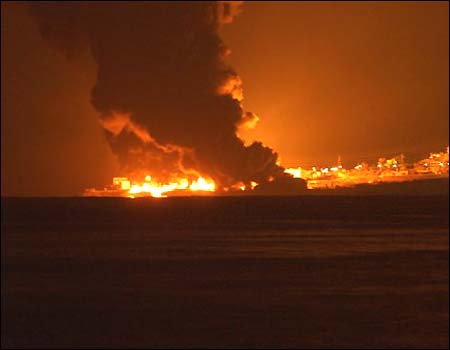
A fuel tank burns in southern Lebanon.

A moment of truth


This war upon Israel provides a moment of clarity for the world. David Horowitz writes that it is a "Moment of truth" for Americans and freedom-loving people everywhere. His words are prophetic and incisive:

Americans need to take a hard look at what is going on in the Middle East, because it provides the clearest picture possible of the war we are in. On one side are al-Qaeda, Hamas, Hizbollah, Syria and Iran and their allies: Russia, France, Greece, and the UN majority. On the other is the only democracy in the land of Muslim and Arab terror. The origins of this front in the war on terror are crystal clear: the desire of the Muslim terrorists -- the elected majority among Palestinian Arabs and the occupying Shi'ite army in Lebanon, backed by Syria and Iran -- to destroy Israel and push the Jews into the sea.

The war reveals the impossibility of a Palestinian state and the necessity of a civilized occupying force in a region that is populated by a people who have been terminally brainwashed into an ideology of hate, which makes their self-government a crime waiting to happen.

There were 10,000 Jews living in Gaza until recently. They were so creative that while representing less than one percent of the population they accounted for 10% of the entire gross national product of the country. Productive and law-abiding as they were, their existence in Gaza required a Israeli army presence to protect them. So uncontrollable is the genocidal hatred of Palestinians for Jews (more than a million Palestinians on the other hand live peacefully in Israel enjoying more rights than any Arabs or Muslims living in their own countries). The Israeli army in Gaza was also necessary to prevent genocidal Palestinians Jew-haters from lobbing rockets into Israeli schoolyards.

Eventually, the Israeli leadership made a decision to capitulate to Arab Jew hatred and uproot the Jews living in Gaza, and to withdraw the forces that protected Israel from being attacked by Arab criminals. In the months that followed, the Arabs did nothing to improve their new homeland, which they now controlled completely. Instead, they elected genocidal terrorists to govern them. They destroyed the horticulture industry the Jews had created and that provided 10% of their GNP. They lobbed 800 or so rockets into Israel. During all this mayhem no word of condemnation for the Gaza aggressors came from the UN, France, Russia and rest of the Jew-hating, terrorist-appeasing and terrorist-supporting international community.

Consequently, the Hamas army command, based in Syria, authorized a further aggression -- a tunnel into Israel and the kidnapping of an Israeli soldier. For good measure, Palestinians in the West Bank executed an 18-year old Jewish hitch-hiker for the crime of being a Jew. Still no condemnation of the Palestinians from the Jew-haters in France, Russia and at the UN. This support encouraged Iranian-sponsored Hizbollah to initiate another aggression, this time from the north...

Read the whole thing. It's time the truth is told about the war foisted upon Israel -- silent and deadly most of the time, now it has boiled over into open conflict; yet this conflict is only a sign of what is to come, if this Jew hating terror is not stopped -- in its local iterations and its theocratic patron states of terror.

Israel has withdrawn from all "occupied territories," and still she is relentlessly attacked -- yea, attacked even more since she withdrew!

What does this tell you about the aims of the people who attack her?

Are we willing to see the truth?

Selah.

Tuesday, July 04, 2006

Testing whether that nation can long endure


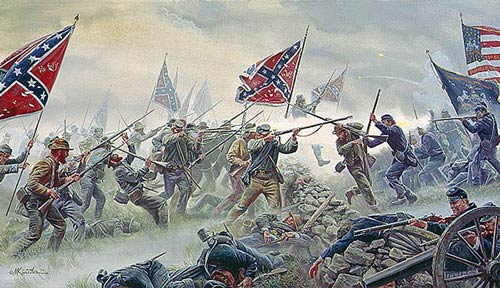
High tide of the Confederacy ends at a stone wall
in a Pennsylvania field [Mort Kunstler painting]


The meaning of the 4th of July

In the hot afternoon sun of 3 July 1863, Federal troops turned back Pickett's final, desperate assault on the center of Union lines at Gettysburg. The smoke of the cannons blotted out the sun, turning it into an eerie red ball hanging in the summer sky; the thunder of shot and shell, cannister and exploding ordinance joined in incessant, deadly chorus with the crashing fire of muskets and rifles: souls streamed toward heaven's door from such battlefield destruction never seen before on human soil.

Waves of shot and shell ripped through the ripening wheat as the fixed, glistening lines of proud Confederate warriers marched through the valley of harvest: "There go the boys that will march through your lines!" one Conderate medic told a wounded Union prisoner. And march they did, to the very gates of hell it seemed, but not through Federal lines that day...

The attack crossed a mile of open field, enduring horrid casualties, briefly pierced the center line at the stone wall, wavered...then fell back: broken, blood poured out like water on shattered wheat -- once waving wheat now flattened under continuous cannon concussion, splattered with the blood of a divided nation.

But what did this fateful attack at Gettysburg mean? And how did it affect that glorious Independance declared 87 years earlier on July 4?

Had the attack succeeded, had Gettysburg ended in Confederate victory, Conderate General Robert E. Lee already had drawn up cease-fire partition plans to submit to President Lincoln in Washington. And such was the state of the war that such "seperate but equal" plan undoubtedly would have been supported by Congress: already Lincoln stood very alone in his resolve of a unified America free of slavery: a war-time President, he carried the weight of the war on his shoulders, to the constant vilification of media and political enemies.

The nation would have been split -- if not irrevocably, at least for a foreseeable future -- and all this would have meant for a world that so desperately needed a whole America.

"A house divided against itself cannot stand," said One who walked this human sod; and a divided house could not have stood against lurking totalitarian evil: the evil within our own national breast threatened our intended power against the evil that would sweep over the world a few decades later.

"Righteousness exalts a nation, but sin is a reproach to any people," said the prophets.

There, in the rolling fields of Gettysburg, the result of sin was seen in spades -- surely angels wept in the shattered atmosphere, where souls lingered in silent tears. Yet mercy was also poured out with the valiant blood: a nation yet stood, Independence still meant light for the world. July 4 now meant far, far more to a fledgling nation, nation humbled under Almighty hand.

When word of Gettysburg [and Vicksburg] reached Lincoln on the 7th, he stood in the early evening of Washington, sober and humble. He spoke to gathered persons and reporters, but was so humble, and so overcome with emotion, that he could only speak a few sentences: he said something to the effect that such occasion demanded a speech so eloquent that he was not up to the task.

He knew the truth: a nation had been preserved.

And later, in his humility, he spoke words worthy of a day of Freedom, words only he could have written and spoken:

Fourscore and seven years ago our fathers brought forth on this continent a new nation, conceived in liberty and dedicated to the proposition that all men are created equal.

Now we are engaged in a great civil war, testing whether that nation or any nation so conceived and so dedicated can long endure. We are met on a great battle field of that war. We have come to dedicate a portion of that field, as a final resting place for those who here gave their lives that that nation might live. It is altogether fitting and proper that we should do this.

But, in a larger sense, we can not dedicate -- we can not consecrate -- we can not hallow -- this ground. The brave men, living and dead, who struggled here, have consecrated it, far above our poor power to add or detract. The world will little note, nor long remember, what we say here, but it can never forget what they did here. It is for us the living, rather, to be dedicated here to the unfinished work which they who fought here have thus far so nobly advanced. It is rather for us to be here dedicated to the great task remaining before us -- that from these honored dead we take increased devotion to that cause for which they gave the last full measure of devotion -- that we here highly resolve that these dead shall not have died in vain -- that this nation, under God, shall have a new birth of freedom -- and that government of the people, by the people, for the people, shall not perish from the earth.

Happy Independance Day, America!

May we never forget the meaning of July 4, and how this meaning has been measured and defended in blood on subsequent July 4ths -- a new birth of freedom. May we take renewed devotion to the task yet before us, pleading the grace of God!

And may we never lack in standing against evil in our own time, in our own hearts...

Selah.

Friday, January 20, 2006

A mystic power at Gettysburg


Gettysburg, Pennsylvania

By Nancy Roberts

This story is about a moment when the choice of one road over another was critical to the future of a nation, when the guidance seen by an entire regiment of men was so bizarre that it can only have come from the realm of the supernatural.

On July 1, 1863, the Twentieth Maine under Colonel Joshua Chamberlain and Colonel Adelbert Ames’s brigade were heading north from Maryland into Pennsylvania to repel Lee’s invasion. Above the marching men, smoke-colored dust billowed and drifted as their column wound along-a solid mass of dark and light blue punctuated by the steely glint of rifles. Infantrymen helped themselves to the large sweet cherries beside the road as they passed through lush green Maryland farm country with knee-high corn and ripening grain.

Leaving the sometimes hostile state of Maryland and crossing into Pennsylvania, the drum corps struck up “Yankee Doodle,” but the inhabitants behind their roadside stands selling bread, milk, cakes, and pies did not respond to this patriotic gesture. Seeing this, many of the hungry men, outraged at the prices, began to help themselves.

“Thieving Rebels!” angry vendors shouted at them. It was the worst insult they could think of. The Union troops ignored them. But the farther north they went, the friendlier people became and the lower the prices.

Nearing Hanover, Pennsylvania, that afternoon, they had a shock. All around lay dead horses and Union cavalrymen with eyes staring upward as though they had seen a sight too horrible to tell. What had happened? Confederate general Jeb Stuart had been through here with a large force of cavalry and skirmished briefly as he passed. The audacious Stuart, emerging from the Blue Ridge Mountains, had galloped boldly around the entire Federal army, past its right flank, proceeding to sever all telegraph lines linking General Meade to his high headquarters in Washington.

Late that afternoon a tired Colonel Chamberlain and his men bivouacked just outside Hanover, and the colonel sat alone, grateful for fresh bread and milk from one of the vendors. What a surprising life he was leading! A graduate of a theological seminary, his only training in supervision had been to run a Sunday school and teach at Bowdoin College. Now thirty-three, he saw soldiering as a romantic adventure. It was downright un-Christian for a man trained for the ministry, he thought with some chagrin.

Watching curiously as a rider, his horse lathered, rode up to brigade commander Ames, he knew it was bad news. The First and Eleventh Corps had run into Lee at a town to the west called Gettysburg. General Reynolds had been killed, and Confederates had pursued the First Corps into town. Union soldiers not taken prisoner were dug in on some hills on the Hanover side of Gettysburg waiting for help. In July, 1863, there were only twenty-four hundred residents in Gettysburg, but the little town was at the center of a network of ten important roads – two leading west to passes in South Mountain, others to Harrisburg, Baltimore, and nearby towns. Some were meandering farm roads rambling over ridges or encircling the bases of scattered granite hills.

Shoving the rest of the homemade bread in his haversack, Chamberlain ordered his tired men to break camp and march. Gettysburg was a dozen miles to the west. In three days – from July 1 to July 3, 1863 – more than one hundred seventy thousand men would shoot, knife, grapple, and kill each other here until pools of blood stood in the small depressions upon the rocks.

Chamberlain himself rode at the head of the column, his well-muscled body erect, a striking man with finely shaped head and classic profile, his dashing moustache swept back from the upper lip. Overhead, the moon rose, and when it was not concealed by the clouds, both soldiers and the Pennsylvania countryside were washed in pale golden light. Along winding, rutted roads, through forests, across fields, and past an occasional farm house, they marched in silence.

And if the minds of these men from Maine sometimes turned homeward, it was to dream of white farm houses and coastal villages, gulls wheeling over blue water and stony shores, fishing boats bobbing on tossing waves, sequestered forests with axes ringing in the cold winter dawn, oxen and stocky farm horses laboring to drag gleaming plow blades through stony earth, and the scent of lilacs in the spring. Spurs constantly led off the road the two colonels had agreed was the most direct. But finally, when they knew they must be getting close to Gettysburg, they came to what appeared to be an important fork. Here the Twentieth Maine halted while the officers debated over which direction to take.

Suddenly the clouds parted, and the moon shone down upon a horseman wearing a bright coat and tricorn hat. Mounted on a magnificent pale horse, he cantered down one of the roads branching off before them. Turning slightly toward them, he waved them to follow.

In his later report Chamberlain described the event.

“At a turn of the road a staff officer, with an air of authority, told each colonel as he came up, ‘General McClellan is in command again, and he’s riding up ahead of us on the road.’

“Men waved their hats, cheered until they were hoarse, and, wild with excitement, followed the figure on horseback. Although weary, they marched with a miraculous enthusiasm believing that their beloved general had returned to lead them into battle.”

Soon an awed murmur began to travel from one man to another, back through the ranks of troops. Now a different name was heard.

“It’s Washington!” exclaimed the men to each other, passing the magic name along. “General Washington himself come to lead us!” And they followed.

The very air was charged with energy and confidence. Although they had no foreknowledge of where they were going or how the land lay, Chamberlain and his Twentieth Maine were on their way to one of the most strategic positions in the coming battle.

When Chamberlain’s men arrived at the edge of a wheatfield, they waited, gathered for instructions. Before them the woods were a fearful sight. They seemed to roar as smoke and fiery bursts of light hovered over treetops. Beneath the men’s feet the ground shuddered from bursts of artillery.

Meanwhile Union general Gouverneur K. Warren had ridden to the summit of a hill called Little Round Top. It was a large granite outcropping, and he found it completely undefended. Gazing down at the land around him with the eye of a military engineer and strategist, Warren foresaw its importance. On impulse he sent word to a battery below to fire a shot into the woods. It had its effect. The projectile above the trees caused the ranks of Confederates who were concealed in the forest to look up. When they did, their shifting bayonets caught the rays of the sun and reflected hundreds of flashes of light visible to the Union general.

General Warren thought about the line in Byron’s poem about the Assyrians: “And the sheen of their spears was like stars on the sea when the blue wave rolls nightly on deep Galilee.”

He was badly shocked by the enemy’s numbers. So long was the Confederate battle line that it could easily outflank the Union left. It would enable General Longstreet and his men to capture Little Round Top. Warren saw the hill as the key to victory. He immediately sent for help, and Colonel Chamberlain’s men were in the ideal position to respond quickly.

There was no easy approach to this ugly rock-strewn mound of stone called Little Round Top. Colonel Strong Vincent started toward the northwest slope, but he found the rock side too rough to mount. He and Chamberlain stood the base of the hill, conferred, and decided to go up through some woods. Vincent, followed by Chamberlain, began scrambling up the incline. By now the Confederates realized what was happening and were sweeping the lower part of the hill with artillery fire…

First to charge the Twentieth Maine was the 4th Alabama – lean, fierce men crouched among the rocks. The smoke of their gunfire spread across the Twentieth Maine’s entire front. No sooner had the attack begun than a lieutenant spied a mass of Confederates vastly outnumbering the Twentieth Maine advancing toward their flank. It was to be only the first of a multitude of tactical problems they would have.

The great dilemma came in less than two hours. The Twentieth Maine had only sixty rounds per man. They had fired almost every round, and for a short time there was a lull. Colonel Chamberlain stood off alone thinking. His men would be slaughtered here…and so would he.

Meanwhile, across the valley, a Confederate soldier saw the solitary Union officer with a flowing black mustache standing just behind the center of the lines of the Twentieth Maine. From the man’s demeanor, the Confederate knew he must be either the general or an extremely important commander. To steady his rifle the sold rested his rifle upon a large rock. Viewing his human target over the sights, he took aim, but when he started to pull the trigger he felt a strange reluctance to kill the man. He sighted again. This time he was determined to shoot. Once more, to his bewilderment, he was unable to squeeze the trigger.

Now disaster was only minutes away for the Twentieth Maine, and all down the line men’s hoarse, frantic voices shouted, “Ammunition! For God’s sake! Ammunition!”

Hastily they began to search the bodies around them on the ground. They stripped cartridge boxes off the dead and dying and tore them open in their haste. But there was not enough. Men who had fired their last rounds turned desperately to Chamberlain, who had been considering the alternatives. Ordered to hold the ground at all costs, they could not withdraw. There just wasn’t any good option. Then this colonel, who seemed to have a talent for doing the impossible, stepped forward.

Only surprise might work. The men of the Twentieth Maine heard his commanding voice ring out above the sounds of battle.

“Fix Bayonets! Charge!”

Shocked, for a long, tense moment they didn’t move – fishermen, farmers, woodsmen, just ordinary men. They hesitated as men do when facing incredible odds, possibly death. Would they obey?

Suddenly, an imposing figure stood in front of the line, exhorting them to follow. The rays of the afternoon sun set his upraised sword aflame. Once more the Twentieth Maine was seized by the same exultation they had felt following the phantom horseman on the road to Little Round Top Round Top. He was leading them again! Inspired by supernatural bravery they plunged down the hill thrusting their bayonets into the ranks of the amazed Alabamians. Bewildered, the Confederates had no time to fire a decisive volley, and as they fell back their line broke. In spite of courage, weapons, and superior numbers, they fled.

Chamberlain and his Twentieth Maine had performed one of the miracles of the war. Seldom in the annals of history has there been a more baffling defeat.

John Pullen, author of The Twentieth Maine, describes it best when he says,

“To find any parallel, it would almost be necessary to go back to Second Kings, 7:3, wherein the four leprous men said to one another, ‘Why sit we here until we die?’ Then they rose up and advanced into the camp of the Syrians, the Lord at the proper moment causing the Syrians to hear ‘a noise of chariots and a noise of horses, even the noise of a great host,’ so that the Syrians all fled for their lives.”

When General Joshua Chamberlain was an old man, an interviewer asked him, “Is there any truth to the story that your men saw the figure of George Washington leading them at Gettysburg?”

Chamberlain gazed thoughtfully out of the window of his home across the Maine fields, and there was a long pause. Then he nodded.

“Yes, that report was circulated through our lines, and I have no doubt that it had a tremendous psychological effect in inspiring the men. Doubtless it was a superstition, but who among us can say that such a thing was impossible? We have not yet sounded or explored the immortal life that lies out beyond the Bar.

“We know not what mystic power may be possessed by those who are now bivouacking with the dead. I only know the effect, but I dare not explain or deny the cause. I do believe that we were enveloped by the powers of the other world that day and who shall say that Washington was lot among the number of those who aided the country that he founded?”


_________________

Excerpted from Nancy Roberts, “A Mystic Power at Gettysburg,” Civil War Ghost Stories and Legends (Columbia: University of South Carolina Press, 1992), 60-70. Note: Nancy is an elegant writer, as witnessed by this piece. She is faithful to the original documents and sensitive to the subject material. She has impressed me with her work, and I’ll be sharing more from her in the future, hopefully.


Wednesday, January 11, 2006

A heavenly ghost story

I heard his music

I heard his music, as if I was hearing music for the first time.

My hands felt heart-drawn to make music, and my soul danced with the tune. It was the perfect mingling of joy and sorrow – sorrow redeemed. The soul that made that music, oh! I entered the music and found worship there…something indescribable, indefinable and pure. I closed my eyes and bowed my head...

Then I glanced behind me and there he was, seated to one side with a slight smile on his face, glowing and healthy, full color. I had never seen a ghost before. But if this was a ghost, where was the fear? I was seeing a brother in Christ.

Surprise is not the word. Perhaps the music prepared me: seeing his soul in the music I felt no shock at his form.

I addressed him first, with the first words in my mind. “How is it in heaven?” I asked. He gave a smile and some reply of its beauty. Then I asked him, “What are the relationships like there?” He had begun to fade, but when I asked this question he became animated: “Oh, if I could tell you!” he said. “Relations there are everything relation was meant to be.”

He was caught in the rapture of the relations. Perhaps they reflected the fulfillment of his earthly music? Then he paused. “But we are at war, you know,” he said, with a touch of sadness.

I felt the rebuke in those gentle words. My breath caught, and I answered, “Yes, I know.” What else could I say?

He continued: “Every day there is silence in heaven and the angels are drawn to the ramparts, looking down on earth.” “Here we know the seriousness of battle. But there is a pause before heaven’s arrows are loosed, and in that moment of stillness the anointing of heaven is poured down to individual souls, as droplets of inner gold, pure grace.”

And here he grew thoughtful, almost sad. “But sometimes that anointing is only for a few souls, two or three out of all the earth’s need.”

And then I understood: the anointing of heaven depended on the prayers of the children. Heaven wanted to give so much more, as prelude to victorious battle!

Then the full rebuke in those words fell on me. “But we are at war, you know.”

My mind went to all the times I wanted to pretend that this life was a holiday, a place to rest and receive accolades and peace. My mind went to all the times where my prayers didn’t request the grace of heaven for others caught in the battle.

The reproach entered my soul not as condemnation, but as a gentle, chiding awareness. Such is the breath of heaven…

I awoke, and in the awakening further awareness came: true music is a weapon of heaven, a prayer, a worshipful, healing balm. Children at worship are children at war, calling down grace in the music of heaven, healing for souls in battle.

And so I write this story with a moral, for those who are called.

And I pray to live the moral!

God grant that I will request heaven’s anointing for the souls on my heart before I sleep again. And that I purpose to let heaven declare my holidays, from this time on, for the glory of the kingdom and the healing of His beautiful daughters and sons…

And may that grace be poured on those I love and those He loves before this night is through!

Alleluia!

Amen.


Friday, October 21, 2005

A song for the heart

Pelennor Fields

I deem that she yet lives

Imrahil, Prince of Dol Amroth, rode up and drew rein before them.

‘What burden do you bear, men of Rohan?’ he cried.

‘Theoden King,’ they answered. ‘He is dead. But Eomer King now rides in the battle: he is with the white crest in the wind.’

Then the prince went from his horse, and knelt by the bier in honor of the king…and he wept. And rising, he looked then on Eowyn and was amazed. ‘Surely, here is a woman?’ he said. ‘Have even the women of the Rohirrim come to war in our time of need?’

‘Nay! One only,’ they answered. ‘The Lady Eowyn is she, sister of Eomer; and we knew naught of her riding until this hour, and greatly we rue it.’

Then the prince, seeing her beauty, though her face was pale and cold, touched her hand as he bent to look more closely on her. ‘Men of Rohan!’ he cried. ‘Are there no leeches among you? She is hurt, to the death maybe, but I deem that she yet lives.’ And he held the bright-burnished vambrace that was upon his arm before her cold lips, and behold! a little mist was laid on it, hardly to be seen…

Out of dark to the day's rising

Stern now was Eomer’s mood, and his mind was clear again. He let blow the horns to rally all men to his banner that could come thither; for he thought to make a great shield-wall at the last, and stand, and fight there on foot until all fell, and do deeds of song on the fields of Pelennor, though no man be left in the West to remember the King of the Mark. So he rode to a green hillock and there set his banner, and the White Horse ran rippling in the wind.

Out of doubt, out of dark to the day's rising
I came singing in the sun, sword unsheathing.
To hope's end I rode and to heart's breaking:
Now for wrath, now for ruin and a red nightfall!

These staves he spoke, yet he laughed as he said them. For once more lust of battle was upon him; and he was still unscathed, and he was young, and he was king: the lord of a fell people. And lo! even as he laughed at despair he looked out again on the black ships, and he lifted up his sword to defy them.

And then wonder took him, and great joy; and he cast his sword up in the sunlight and sang as he caught it. And all eyes followed his gaze, and behold! upon the foremost ship a great standard broke, and the wind displayed it as she turned toward the Harlond. There flowered a White Tree, and that was for Gondor; but Seven Stars were about it, and a high crown above it, the signs of Elendil that no lord had borne for years beyond count. And the stars flamed in the sunlight, for they were wrought with gems by Arwen, daughter of Elrond; and the crown was bright in the morning, for it was wrought of mithril and gold. The king!

Out of the paths of the dead

Thus came Aragorn son of Arathorn, Elessar, Isilur’s heir, out of the Paths of the Dead, borne upon a wind from the Sea to the kingdom of Gondor; and the mirth of the Rohirrim was a torrent of laughter and a flashing of swords, and the joy and wonder of the City was a music of trumpets and the ringing of bells. But the hosts of Mordor were seized with bewilderment, and a great wizardry it seemed to them that their own ships should be filled with their foes; and a black dread fell upon them, knowing that the tides of fate had turned against them and their doom was at hand.

Let us avenge it, ere we speak of it

And so at length Eomer and Aragorn met in the midst of the battle, and they leaned on their swords and looked at one another and were glad.

‘Thus we meet again, though all the host of Mordor lay between us,’ said Aragorn. ‘Did I not say so at the Hornburg?’

‘So you spoke,’ said Eomer, ‘but hope oft deceives, and I knew not then that you were a man foresighted. Yet twice blessed is help unlooked for, and never was a meeting of friends more joyful.’ And they clasped hand in hand. ‘Nor indeed more timely,’ said Eomer. ‘You come none too soon, my friend. Much loss and sorrow has befallen us.’

‘Then let us avenge it, ere we speak of it!’ said Aragorn, and they rode back to battle together.

The Houses of Healing

She lies within and is not dead

Eomer said, ‘Where is the Lady Eowyn, my sister; for surely she should be lying beside the king, and in no less honor? Where have they bestowed her?

And Imrahil said, ‘But the Lady Eowyn was still living when they bore her hither. Did you not know?’

Then hope unlooked-for came so suddenly to Eomer’s heart, and with it the bite of fear and care renewed, that he said no more, but turned and went swiftly from the hall; and the Prince followed him. And when they came forth evening had fallen and many stars were in the sky. And there came Gandalf on foot and with him one cloaked in grey; and they met before the doors of the Houses of Healing. And they greeted Gandalf and said: ‘We seek the Steward, and men say that he is in this House. Has any hurt befallen him? And the Lady Eowyn, where is she?’

And Gandalf answered, ‘She lies within and is not dead, but is near death…’ And they were filled with fear and wonder at the tale that he told.

But Imrahil said, ‘So victory is shorn of gladness, and it is bitter bought…’ ‘Shall we not send now for the Lord Aragorn?’

And the cloaked man spoke and said, ‘He is come.’ And they saw that as he stepped into the light of the lantern by the door that it was Aragorn, wrapped in the grey cloak of the Lorien above his mail, and bearing no other token than the green stone of Galadriel…

Then Gandalf said, ‘Let us not stay at the door, for the time is urgent. Let us enter! For it is only in the coming of Aragorn that any hope remains for the sick that lie in the House. Thus spake Ioreth, wise-woman of Gondor: The hands of the king are the hands of a healer, and so shall the rightful king be known.’

The hands of the king

Aragorn came to Eowyn and said: ‘Here is a grievous hurt and a heavy blow. The arm that was broken has been tended with due skill, and it will mend in time, if she has the strength to live; but the chief evil comes through the sword-arm. In that there now seems no life, although it is unbroken.

‘Alas! For she was pitted against a foe beyond the strength of her mind or body. And those who take a weapon to such enemy must be sterner than steel, if the very shock shall not destroy them. It was…doom that set her in his path. For she is a fair maiden, fairest lady of a house of queens…

Then Aragorn stooped and looked in her face, and it was indeed white as a lily, cold as frost, and hard as graven stone. But he bent and kissed her on the brow, and called her softly, saying:

‘Eowyn Eomund’s daughter, awake! For your enemy has passed away!’

She did not stir, but now she began again to breathe deeply, so that her breast rose and fell beneath the white linen of the sheet. Once more Aragorn bruised two leaves of athelas and cast them into steaming water; and he laved her brow with it, and her right arm lying cold and nerveless on the coverlet.

Then, whether Aragorn had indeed some forgotten power of the Westernesse, or whether it was but his words of the Lady Eowyn that wrought on them, as the sweet influence of the herb stole about the chamber it seemed to those who stood by that a keen wind blew through the window, and it bore no scent, but was an air wholly fresh and clean and young, as if it had not been before breathed by any living thing and came new-made from snowy mountains high beneath a dome of stars, or from shores of silver far away washed by seas of foam.

‘Awake, Eowyn, Lady of Rohan!’ said Aragorn again, and he took her right hand in his and felt it warm with life returning. ‘Awake! The shadow is gone and all darkness is washed clean!’

Your watch hath not been in vain


Sing now, ye people of the Tower of Anor,
for the Realm of Sauron is ended for ever,
and the Dark Tower is thrown down.

Sing and rejoice, ye people of the Tower of Guard,
for your watch hath not been in vain,
and the Black Gate is broken,
and your King hath passed through,
and he is victorious.

Sing and be glad, all ye children of the West,
for your King shall come again,
and he shall dwell among you
all the days of your life.

And the Tree that was withered shall be renewed,
and he shall plant it in the high places,
and the City shall be blessed.

Sing all ye people!

Sing, all ye people!

Tuesday, September 20, 2005

Destiny in blood and fire at Gettysburg


Warrior of Providence

Piecing together the epic battle of Gettysburg, I’ve found such dramatic stories of Providence, that…in the words of one commander, ‘Only a fool or infidel could deny’ the hand of God in it all. Shelby Foote, the famous Civil War historian, once commented that it was ‘as if the very stars aligned in their courses against Lee’ at Gettysburg, to draw him into battle and then to cause him to throw his men away in Pickett’s [or Longstreet’s] charge on the third day.

And, that seems to be the case. The little details, the ‘chance’ occurrences of terrain, men and events, were arranged in such a way that the Federals won the battle. The more one studies the battle, the more these details pile up and leap out…as an avalanche of ‘improbable’ events, men and positions, piled one upon another, to turn back the Confederate tide.

Among this tide of providential details is the story of Col. Joshua L. Chamberlain and the 20th Maine.

I’ve commented before on the character of this man, and the actions of the 20th at Gettysburg. But here, I’d like to set up the context of those days in July so that readers can sense the power of events for themselves.

The battle at Gettysburg engaged on the first of July, where, by all accounts…the Confederates smashed the Federal troops, with heavy losses. The 20th Maine and the Fifth Corps spent this day marching, only to find themselves 16 or so miles from Gettysburg and the crucial battle by night’s end.


A night when the powers of another world drew nigh
July 1, 1863

The Fifth Corps marched to Hanover, Pennsylvania – Col. Chamberlain and the 20th Maine lay down by the road to get some rest…only to receive urgent orders: ‘Get up and march to Gettysburg!’
Nightfall brought us to Hanover, Pennsylvania, and to a halt. And it was the evening of the first day of July, 1863. All day we had been marching north from Maryland, searching and pushing out on all roads for the hoped-for collision with [Gen. Robert E.] Lee eagerly, hurriedly, yet cautiously, with skirmishers and flankers out to sound the first challenge, and our main body ready for the call…

Worn and famished we stacked arms in camping order, hoping to bivouac beside them… Some of the forage wagons had now got up, and there was a brief rally at their tail ends for quick justice to be dispensed. But the unregenerate fires had hardly blackened the coffee-dippers, and the hardtack hardly been hammered into working order by the bayonet shanks, when everything was stopped short by whispers of disaster away on the left: the enemy had struck our columns at Gettysburg, and driven it back with terrible loss; [John F.] Reynolds, the commander, had been killed, and the remnant scarcely able to hold on to the hillsides unless rescue came before morning. These were only rumors flitting owl-like, in the gathering shadows. We could not quite believe them, but they deepened our mood.

Suddenly the startling bugle-call from unseen headquarters! “The General!” it rang! “To the march! No moment of delay!”

Word was coming, too. Staff officers dashed from corps, to division, to brigade, to regiment, to battery and the order flew like the hawk, and not the owl. “To Gettysburg!” it said -- a forced march of sixteen miles. But what forced it? And what opposed? Not supper, nor sleep, nor sore feet and aching limbs.

In a moment, the whole corps was in marching order; rest, rations, earth itself forgotten; one thought -- to be first on that Gettysburg road. The iron-faced veterans were transformed to boys. They insisted on starting out with colors flying, so that even the night might know what manner of men were coming to redeem the day.

At a turn of the road a staff officer, with an air of authority, told each colonel as he came riding up, that McClellan was in command again, and riding ahead of us on the road. Then wild cheers rolled from the crowding column into the brooding sky, and the earth shook under the quickened tread. Now from a dark angle of the roadside came a whisper, whether from earthly or unearthly voice one cannot feel quite sure, that the august form of Washington had been seen that afternoon at sunset riding over the Gettysburg hills. Let no one smile at me! I half believed it myself -- so did the powers of the other world draw nigh![1]

So after their 12 hour march to Hanover, PA, without rest or cooked rations, they force-marched all night to reach Gettysburg by the 2nd of July.

Hold this ground at all costs!

July 2, 1863

They reached Gettysburg in the morning, and slept on their arms beside the road.

Again the bugle ordered them forward. They entered the field to general chaos and disorder. Amidst the shells and cries for help, Col. Vincent, their commanding officer, heard that Little Round Top was unprotected. Without divisional orders, immediately ordered the Fifth Corps forward, and placed the little 20th Maine on the end of the line.
Reaching the southern face of Little Round Top, I found Vincent there, with intense poise and look. He said with a voice of awe, as if translating the tables of the eternal law, ‘I place you here! This is the left of the Union line. You understand. You are to hold this ground at all costs!’

Chamberlain said that ‘he understood, but was yet to learn about costs.’ He prepared his men to fight ‘at all costs,’ i.e. to fight to the death, if need be.[2]

Captain Howard Prince later related the actions of Chamberlain in the moments before the battle:
Up and down the line, with a last word of encouragement or caution, walks the quiet man, whose calm exterior concealed the fire of the warrior and heart of steel, whose careful dispositions and ready resource, whose unswerving courage and audacious nerve in the last desperate crisis, are to crown himself and his faithful soldiers with...fadeless laurels.[3]

In less than 10 minutes they were attacked. They had literally reached the decisive point of the battle with only minutes to spare.

Immediately, members of the 4th and 47th Alabama regiments attacked their front, and the 20th Maine was hotly engaged.

During the attack, an adjutant alerted Chamberlain a movement of Confederates between the Round Tops towards his left flank. He climbed a rock to see this new development, and sure enough…behind the main attack line, the 500 man 15th Alabama under Colonel William C. Oates was stealthily moving to enfilade his left flank.

But he had no more men for the flank!

Coolly, he ordered his men to keep firing, and take several steps to the left. In this manner he lengthened the thin line, then doubled them back at a right angle. In military terms, this is called ‘refusing the line.’ And he did it under extreme fire, totally outmanned. When the 15th Alabama charged in, instead of crushing an unprotected line, they met a volley of fire, which stunned them and threw them back. “The execution of this difficult maneuver while under fire is a tribute to the regiment’s training and discipline and to Chamberlain’s resourcefulness.”[4]

However, this move, as brilliant as it was, only postponed the inevitable. The 20th Maine just simply didn’t’ have enough men or firepower to hold the position. Their line was spread too thin, and now almost doubled back upon itself.
The roar of all this tumult reached us on the left, and heightened the intensity of our resolve. Meanwhile the flanking column worked around to our left and joined with those before us in a fierce assault, which lasted with increasing fury for an intense hour. The two lines met and broke and mingled in the shock. The crush of musketry gave way to cuts and thrusts, grapplings and wrestlings. The edge of conflict swayed to and from, with wild whirlpools and eddies. At times I saw around me more of the enemy than of my own men: gaps opening, swallowing, closing again with sharp convulsive energy; squads of stalwart men who had cut their way through us, disappearing as if translated. All around, strange, mingled roar-shouts of defiance, rally, and desperation; and underneath, murmured entreaty and stifled moans; gasping prayers, snatches of Sabbath song, whispers of loved names; everywhere men torn and broken, staggering, creeping quivering on the earth, and dead faces with strangely fixed eyes staring stark into the sky. Things which cannot be told -- nor dreamed.

How men held on, each one knows, not I. But manhood commands admiration.

There was one fine young fellow, who had been cut down early in the fight with a ghastly wound across his forehead, and who I had thought might possibly be saved with prompt attention. So I had sent him back to our little field hospital, at least to die in peace. Within a half-hour, in a desperate rally I saw that noble youth amidst the rolling smoke as an apparition from the dead, with bloody bandage for the only covering of his head, in the thick of the fight, high-borne and pressing on as they that shall see death no more. I shall know him when I see him again, on whatever shore![5]

After an hour and a half of this desperate fighting, the little 20th Maine had nothing left to give. Facing 3-1 or 4-1 odds, on little sleep, two-days march, and low ammunition, they could not stand another blow. Six times the enemy had assaulted them. Five times their thin line had been penetrated and almost shattered. The seventh assault would be their last.
Our thin line was broken, and the enemy were in rear of the whole Round Top defense -- infantry, artillery, humanity itself -- with the Round Top and the day theirs. Now, too, our fire was slackening; our last rounds of shot had been fired; what I had sent for could not get to us. I saw the faces of my men one after another, when they had fired their last cartridge, turn anxiously towards mine for a moment; then square to the front again. To the front for them lay death; to the rear what they would die to save…

In his battle report, Chamberlain described it this way:
The enemy seemed to have gathered all their energies for their final assault. We had gotten our thin line into as good a shape as possible, when a strong force emerged from the scrub wood in the valley, as well as I could judge, in two lines in echelon by the right, and, opening a heavy fire, the first line came on as if they meant to sweep everything before them. We opened on them as well as we could with our scanty ammunition snatched from the field.

It did not seem possible to withstand another shock like this now coming on. Our loss had been severe. One-half of my left wing had fallen, and a third of my regiment lay just behind us, dead or badly wounded. At this moment my anxiety was increased by a great roar of musketry in my rear, on the farther or northerly slope of Little Round Top, apparently on the flank of the regular brigade, which was in support of Hazlett's battery on the crest behind us. The bullets from this attack struck into my left rear, and I feared that the enemy might have nearly surrounded the Little Round Top, and only a desperate chance was left for us. My ammunition was soon exhausted. My men were firing their last shot and getting ready to “club” their muskets.

It was imperative to strike before we were struck by this overwhelming force in a hand-to-hand fight, which we could not probably have withstood or survived. At that crisis, I ordered the bayonet. The word was enough. It ran like fire along the line, from man to man, and rose into a shout, with which they sprang forward upon the enemy, now not 30 yards away. The effect was surprising; many of the enemy's first line threw down their arms and surrendered. An officer fired his pistol at my head with one hand, while he handed me his sword with the other. Holding fast by our right, and swinging forward our left, we made an extended “right wheel,” before which the enemy's second line broke and fell back, fighting from tree to tree, many being captured, until we had swept the valley and cleared the front of nearly our entire brigade.[6]

It was a glorious, improbable victory. Entering the fight with 358 men, only 200 remained for the charge… In the charge, these 200 took 400 prisoners, from 5 different Confederate regiments…which gives a sense of the magnitude of the assault force before them – battle hardened regiments from Hood’s and Longstreet’s divisions yielding to a thin blue Federal line bereft of ammunition!

Colonel Oates of the 15th Alabama would later write: “There never were harder fighters than the 20th Maine men and their gallant Colonel. His skill and persistency and the great bravery of his men saved Little Round Top and the Army of the Potomac from defeat. Great events sometimes turn on comparatively small affairs.”[7]

Singular guidance of Providence

  • A scholar and professor, Chamberlain should not have been in battle. His college did not permit him to join, so he took several days leave of absence and signed up!
  • He was not West Point trained; yet he trained himself and the regiment into one of the best in the Union Army.
  • God gifted him with a brilliant mind, trained in classics, half dozen languages, and professor of logic, rhetoric and theology. He turned this brilliance toward understanding the art of war, and understanding men…gifted with the intuitive ability to react instantly to crucial battle demands. Chamberlain commented in a letter to his wife Fanny: “I study, I tell you, every military work I can find. And it is no small labor to master the evolutions of a Battalion and Brigade. I am bound to understand everything.”
  • Of all the Federal officers, none were more creatively equipped than Chamberlain -- intellectually, spiritually or martially -- to be in this exact position that July day in Gettysburg.
  • Of all the Federal regiments, none were more able, man for man, than the 20th Maine [who reflected the leadership of their Col., and trusted him implicitly] to be on the end of the line at Little Round Top.
  • Twice during the battle Chamberlain was wounded. And several times, seemingly protected by Providence: 1. An opposing officer fired a pistol in his face, point blank, only to have it misfire; 2. An opposing Alabama marksman twice had something ‘queer’ come down on him, when he had Chamberlain in his sights.
    Dear Sir: I want to tell you of a little passage in the battle of Round Top, Gettysburg concerning you and me, which I am now glad of. Twice in that fight I had your life in my hands. I got a safe place between two rocks, and drew bead fair and square on you. You were standing in the open behind the center of your line, full exposed. I knew your rank by your uniform and your actions, and I thought it a mighty good thing to put you out of the way. I rested my gun on the rock and took steady aim. I started to pull the trigger, but some queer notion stopped me. Then I got ashamed of my weakness and went through the same motions again. I had you, perfectly certain. But that same queer something shut right down on me. I couldn’t pull the trigger, and gave it up - that is, your life. I am glad of it now, and hope you are.[8]
The proving ground of tough circumstances

  • The 20th Maine formed at Camp Mason in Portland, and under Colonel Ames. Colonel Ames was a notoriously brutal commander, who drilled the men so hard that Chamberlain’s younger brother, Tom, feared that the men would shoot Ames at the first chance, commenting thus: “...Colonel Ames takes the men out to drill and he will damn them up hill and down... I tell you he is about as savage a man you ever saw.” Only after their first combat did the men realize that this over-the-top discipline ensured their survival. Their training made them as close to an elite fighting force as the Civil War knew.
  • The 20th Maine came to Gettysburg after enduring some of the most deadly fighting of the war, at Fredericksburg and Chancellorsville. Originally mustering close to 900 men, they reported to the line at Gettysburg with 358 men and 28 officers, and this including the addition of 120 court-martialed men from the 2nd Maine, whom Chamberlain convinced to fight with them.
  • The 20th Maine was the Marine Corps of the Federals: trained and proven in the harshest circumstances, almost as if for a single moment in time…holding the line on the rocky slopes of Little Round Top.

The spiritual nature of sacrifice for others

Chamberlain insisted, with great passion, that the sacrifice of his men at Gettysburg and on other fields, be characterized in spiritual terms, as part of the glorious cosmic war against darkness. For this honor, this high chivalry, he paid a price.

Some have said that his stubborn ethics, his code of valor cost him the Senate, and perhaps Presidency…as political enemies undermined him, since they couldn’t control him. But that’s just the kind of man he was. He would not sell out…no, not even for the Senate or President’s power.

The picture of the man is seen, years later, sitting on Little Round Top:
I sat there alone, on the storied crest, till the sun went down as it did before over the misty hills, and the darkness crept up the slopes, till from all earthly sight I was buried as with those before. But oh, what radiant companionship rose around, what steadfast ranks of power, what bearing of heroic souls. Oh, the glory that beamed through those nights and days. Nobody will ever know it here! I am sorry most of all for that the proud young valor that rose above the mortal, and then at last was mortal after all; the chivalry of hand and heart that in other days and other lands would have sent their names ringing down in song and story!

They did not know it themselves -- those boys of ours whose remembered faces in every home should be cherished symbols of the true, for life or death -- what were their lofty deeds of body, mind, heart, soul on that tremendous day.

Unknown -- but kept! The earth itself shall be its treasurer. It holds something of ours besides graves. These strange influences of material nature, its mountains and seas, its sunset skies and nights of stars, its colors and tones and odors, carry something of the mutual, reciprocal. It is a sympathy. On that other side it is represented to us as suffering: The whole creation travailing in pain together, in earnest expectation, waiting for the adoption -- having the right, then, to something which is to be its own.

And so these Gettysburg hills which lifted up such splendid valor, and drank in such high heart's blood, shall hold the mighty secret in their bosom till the great day of revelation and recompense, when these heights shall flame again with transfigured light -- they, too, have part in that adoption, which is the manifestation of the sons of God!

Rutherford B. Johnson comments:
Such characteristics of subordinating one's own selfish ends to the furtherance of a noble, important, and often life-and-death cause are sorely lacking in today's mainstream society. It is not that they do not exist, but rather that those feeling likewise are fewer today than in certain previous times, and often those feelings are greatly suppressed by popular culture. Yet, in this struggle for the preservation of freedom and indeed our very existence, such characteristics are most essential. Chief among these is moral courage and an inclination to carry out actions, when called, which, no matter how unpleasant or self-endangering, are essential to achieving victory.[9]

It is an abiding lesson of courage, and living to ‘the limits of the soul’s ideal.’

Such Providence, in making the man, and bringing the man to bear in these circumstances, should cause us to reflect on our own greatness, and place in the cosmic war between good and evil.

We were not at Gettysburg. But the good done in private, by a good man or woman, carries on the sacrifice…it ensures that the deeds of valor done on this field, and others, for freedom…were not done in vain. It also echoes again that that highest of deeds from the greatest Warrior of all time…on the Cross…still speaks for victory!

Brave hearts, good hearts, continue still…


Dust of heroes, we will know you...on whatever shore!

“In great deeds something abides. On great fields something stays. Forms change and pass; bodies disappear; but spirits linger, to consecrate ground for the vision-place of souls. And reverent men and women from afar, and generations that know us not and that we know not of, heart-drawn to see where and by whom great things were suffered and done for them, shall come to this deathless field, to ponder and dream; and lo! The shadow of a mighty presence shall wrap them in its bosom, and the power of the vision pass into their souls.”

_________________________

1 Joshua L. Chamberlain, Through Blood and Fire at Gettysburg, published in Gettysburg Magazine No. 6, January 1992 and also published online.
This casual hint of Chamberlain, ‘so did the powers of the other world draw nigh,’ intimates the first real ghost story of Gettysburg: The form of Gen. Washington, dead for 63 years, was reported on the road to Gettysburg, at a crossroads; and then, on the battlefield, at the crucial moment of the bayonet charge: So many of the 15th Alabama claimed to have seen the form of Washington leading the charge that the War Department investigated following the war. And, again, Chamberlain cryptically comments, “Those brave Alabama fellows-- none braver or better in either army--were victims…of their quick and mobile imagination.”
2 Michael Nugent comments:
Chamberlain fully understood the criticality of his mission. If the Confederate forces were able to flank his position, they would gain the rear of the entire Union line with disastrous results… What Chamberlain could not have known, was that in the event of a significant Confederate victory during General Robert E. Lee’s invasion of Pennsylvania, the leaders of the Confederacy intended to present President Lincoln with an offer to pursue a negotiated peace, potentially dividing the Country permanently. [Nugent, “Joshua L. Chamberlain: a Biographical Essay,” Military History Online .
3 Recounted by Pat Finegan, To the Limits of the Soul’s Ideal: My Tribute to Major General Joshua L. Chamberlain.
4 Nugent, “Chamberlain.”
5 Joshua L. Chamberlain, Through Blood and Fire at Gettysburg, published in Gettysburg Magazine No. 6, January 1992 and online.
6 Joshua Lawrence Chamberlain's Report of the Battle of Gettysburg (20th Maine), The American Civil War.
7 Quoted by Nugent, “Chamberlain.”
8 Chamberlain, Through Blood and Fire at Gettysburg.
9 Rutherford B. Johnson, A Personal Essay about Chamberlain's Philosophy, and its Modern Application.

Key resources for further study:

Joshua L. Chamberlain, Bayonet! Forward: My Civil War Reminences, Stan Clark Military Books, 1994. The opening picture of Chamberlain on the horse, colors behind him, is from the cover of this book.

Joshua L. Chamberlain, Through Blood and Fire at Gettysburg, Stan Clark Military Books, 1994. The closing, fighting action picture of Chamberlain holding the sword, with the 20th Maine on Little Round Top, is from the cover of this book.

Alice Rains Trulock. In the Hands of Providence: Joshua L. Chamberlain and the American Civil War. Chapel Hill: University of North Carolina Press, 1992.

To the limits of the soul's ideal. This is a very informative website published by Pat Finegan, on Chamberlain. Lots of nuggets here, in these pages.