Sunday, July 17, 2005

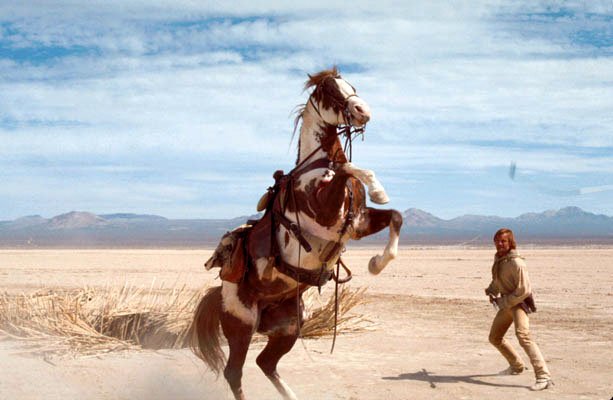
Hidalgo: A horse worth riding


A really neat time Friday night, with Mom -- dinner and a movie. It's not often we get to spend quality time together, so we cherished a few hours in between my trip from WV and return to Chicago. We enjoyed a nice dinner of tomatoes, cucumbers and onions, whole wheat bread, a special chicken dish she makes, and homemade veggie soup. Then we watched Hidalgo [it was either that or The Mummy, which I had already seen, lol].

I was a bit skeptical on the quality of the movie, since the critics had killed it. But -- do I need to say this? Sometimes the critics get it all wrong. And boy, were they wrong on Hidalgo. Or, maybe I'm just a sucker for good movies about horses and dogs, lol. But in my opinion, the movie is excellent.

There are several themes that run throughout the movie which make it very redemptive. The main storyline is about a man trying to find himself, an iron man with an iron horse, who rides 'far away from himself' in life [loosely based on the real life story of Frank T. Hopkins]. His Native name is Blue Boy, but others call him "Far Rider," which he is called not so much because he can ride far and win races, but because he is far from himself...struggling to come to grips with his Native-American ancestry, the past crimes against his Native people, and his inability to make a difference. He slowly dies inside, feeling powerless and trapped. He hides himself in caricature and alcohol...but then a challenge comes to race again -- this time for a lot of money, and this time in Arabia, across 3,000 miles of desert and hatred. The race is more likely to take his life than give him a prize, but either way he wants to be free.

It's a story of personal redemption, the story of a beautiful horse and a true man...who discovers himself in an ocean of burning sand. He is forced by destiny and life...to accept his heritage and place...to live the hero in his soul.

In my opinion, the story is well done. The critics called it cliched and sentimental, but I'll bet none of them have ever wrestled with the inner angst of a man like Far Rider. And I'll just say this: Viggo Mortensen pulls off this lonely, conflicted character about a million times better than Kevin Costner's attempts at the same...and the critics gave Costner a pass [in his weak attempt at Dances with Wolves].

Hidalgo is a great story of Native man and horse, with subplots of Providence: good vs. evil, fatalism vs. partnership with Creator, divine meaning in details...for good.

Mom and I enjoyed it, thoroughly. If that's not reason enough to watch it, why, send me a memo. :-)



Saturday, July 09, 2005

Blogging the Pennsylvania hills


Today I took my mother for a drive through Amish farms. We stopped at a dry goods store, taking care not to park the truck on the buggy section! :-) I got some great deals on dried vegetables and shelled walnuts, hazelnuts and other nuts...literally half the price of what I pay in Chicago for the same items.

We then stopped at a farm where a fresh produce sign hung at the end of a gravel lane. We drove back the lane along well-tended fields, and pulled up to a building with fresh produce...tended by a kind-countenanced woman with several fair-haired children 'helping' her. A black dog moved out of the way so I could park, and I stepped out and whistled softly, it came over and I petted it...made a new friend instantly! Then I bought several containers of fresh tomotoes and cucumbers, enough to do us for the week. Mom and I talked to the lady behind the counter, while the children smiled shyly and listened. She told us where to find fresh corn, newly harvested that day, and we continued on the way. I placed the produce in the bed of my truck, helped Mom in and then pulled out. The young girls ran out and smiled, waving goodbye, with their little brother, too young to talk, waving furiously too...skinned nose and all, just beaming.

A pastoral scene, something right about it. Mom remarked of the wholeness, and I mentioned something to her of the philosophy of C. S. Lewis, who once said that people need to be on the land, caring for it, and feeding from it. He said that dysfunction increases the further one gets from the land. I also observed that the Amish way of life is an attempt to conquer the chaotic force that pervades our world, the 'principalities and powers' of demonic monster Rahav that ever and always opposes Creation order. Mom agreed, and then her eyes glazed over a bit from the *heavy* concepts. It was a good moment, though, in spite of my philosophizing. :-) [And the tomotoes are GREAT!]

Just a great moment, being with her and seeing a 'sanctuary place' from the storms of life, seeing what can be when one creates safe haven for a family or group of children...

Anyway, have to cut this short because I'm speaking tomorrow at the hometown PA church...and then driving to WV for a youth camp. For all those who believe in prayer, I would deeply appreciate your prayers for physical and spiritual strength and wholeness, purity for the days ahead.

I'll try to blog some photos from WV camp area, but until then, good nite and God bless!

Wednesday, July 06, 2005

The calling and gifting of God

Abraham and Sarah as examples of true faith

Even though it was due to Abraham’s particular situation that he was commanded to leave his own country and go to a distant land, and God led him from place to place, nonetheless these words symbolize the calling that all of us receive. We are not simply commanded to leave our country, we are commanded to deny ourselves. We are not commanded to leave our father’s house, but to bid farewell to our own will and to the desire of our human nature. And [whatever things] hinder us from following God, we must forsake them all.

Abraham was simply commanded to depart, and we are also commanded to do so under certain conditions. If in any place we cannot serve God, we must choose to go into exile rather than to stay in our nest, inactive and depressed.

Therefore, let us keep the example of Abraham before our eyes. He is the father of all the faithful, and was tested and tried in every way. Yet he forgot his own country, his friends, and even himself so that he might yield himself completely to God (Rom. 4:16-17).

If we want to be numbered among God’s children, we must not fall short of the example of Abraham [and Sarah].

Acts 7:3, Commentary

Abraham and Sarah are an example of the vocation in us all. For in them we perceive that, by the mere mercy of God, those things which are not are raised from nothing, in order that they may begin to be something.

Genesis 12:1ff, Commentary

God gifts and calls us so that His glory may shine through us


“That you may declare…”

Peter carefully points out the goal of our calling…to move us to give glory to God. The sum of what he says is that God has favored us with these immense benefits which He constantly manifests to us, in order that His glory might be known through us. By “virtues” he means wisdom, goodness, power, righteousness and everything else in which the glory of God shines forth. It also behooves us to these virtues not only by our tongue but also by our whole life. This teaching ought to be the subject of daily meditation…something that we continually remember. Indeed, all God’s blessings which He gives us are intended for this purpose – that His glory might be proclaimed through us.

1 Peter 2:9, Commentary


Sunday, July 03, 2005

Meditation on lilies

Consider the lilies, how they grow: they neither toil nor spin; and yet I say to you, even Solomon in all his glory was not arrayed like one of these…

How is the lily superior to the glory of Solomon?

Solomon’s coffers were filled with literally thousands of tons of gold. He had so much silver that its value plunged during his reign, replacing tin and cheap metals in common usage. His storage overflowed with the most expensive spices and cedar wood. He owned so many horses that he created a vast underground stable complex to house them. And wives? Well, we know about that. He took 700 wives and 300 concubines: 1,000 women at beck and call.

How then is it said that a fragile lily, opening and bending with the sun, is greater in glory than Solomon? Isn’t this crazy talk?

It would seem so, except for the fact that it is Jesus who says these words!

When Jesus says ‘consider the lilies,’ He uses a word which means ‘to see with the mind, to see with the soul.’ In other words, if we can see with our heart, with our soul, there is a lesson in the lily, in the birds of the air and flowers of the field, which sits in judgment of Solomon…and all who take Solomon’s path.

Kierkegaard gives us a clue to this inner meaning: “In nature all is obedience, unconditional obedience.”

D. Anthony Storm comments:
The lilies and the birds obey God naturally. They do exactly what they were created to do without wavering. Since we have volition and intelligence -- not to mention a divided and corrupt nature -- we need to learn obedience. The lilies and birds are thus teachers of obedience by example.

Jesus says more:
If then God so clothes the grass, which today is in the field and tomorrow is thrown into the oven, how much more will He clothe you, O you of little faith? And do not seek what you should eat or what you should drink, nor have an anxious mind. For all these things the nations of the world seek after, and your Father knows that you need these things.

Solomon turned toward the strivings of the world. Solomon turned his wisdom toward what is worn, what is eaten, tasted and pleasurable, and it became foolishness: light became darkness.

The birds of the field, however, turn toward Creator. The lilies turn toward the provision of God’s rain and sun. In that they are true to their creation.

And here they trump Solomon.

For something in the opulence of Solomon went against his creation intention: in exercise of natural self he violated his true-intended self. Therefore the simplicity and poverty of the flower ranks far ahead of the glory of Solomon…and the dependent, soaring bird teaches more obedience than the life of Solomon.

Solomon made empirical identity into a false self, where his 'own self became the obstacle to realizing his true self' [Merton]. His glory became, not the glory of true self in obedience to Creator, but the glory of another. And so it became less than lilies.

Solomon exercised self for possessions and killed his true, creation self.

The lilies exercise daily, utter dependence on God, and so teach us the path to true self: abandonment to kingdom.

So Jesus applies the sermon: But seek first the kingdom of God, and all these things shall be added to you.

Seek the kingdom, wholeheartedly. Trust and open to the Son, like flowers of the field, drinking rain and life from Father's hand. Live and fly, trusting the air of the Spirit beneath your wings, as a hopeful bird...following out creation call.

Herein is the wisdom of the lily!

God grant it to our hearts.

Amen.

Prayer:

Lord Jesus, teach me to be like a lily, daily growing in You, opening to your morning sun, and resting in your sustaining rain, your healing dew. In your name I pray, Amen.

Lord Jesus, set my nature at one with You, cause me to be my true self...in You, and with nature I will rise to obedience, unconditional obedience, Amen.

Lord Jesus, save me from the trap of Solomon, that would make an idol out of false self and call it true self. Let me consider the lily and so seek first your kingdom! In your name, strong Son of God, healing Sun of Righteousness, I pray, Amen.


Saturday, July 02, 2005

Kierkegaard: Prayers to the Father

THE THOUGHT OF THEE

Father in Heaven! When the thought of Thee wakes in our hearts, let it not waken like a frightened bird that flies about in dismay, but like a child waking from its sleep with a heavenly smile.

I WILL CONTINUE TO PRAY

And at times, O Lord, when Thou seemest not to hear my voice, my plaint, my sigh, my thanksgiving, I will even then continue to pray to Thee until Thou hearest my thanksgiving because Thou hast heard me!

HELP US TO PRAY

Grant that our prayer be not like the flower which today is and tomorrow is cast into the oven, not like the flower even though in magnificence it surpasses the glories of Solomon.

LOVE OF THEE MAKETH ELOQUENT

And if one says that earthly love makes one eloquent, how much greater reason for saying the love one bears for Thee will make us eloquent, Thou who formed the mouth of humans for the word!

FOR SELF-MASTERY

Lord! Make our heart Thy temple in which Thou wouldst live. Grant that every impure thought, every earthly desire might be like the idol Dagon – each morning broken at the feet of the Ark of the Covenant. Teach us to master flesh and blood and let this mastery of ourselves be our bloody sacrifice in order that we might be able to say with the Apostle: “I die daily.”

BE NEAR TO US

Our Father, be near to us with Thy power so that we may feel a joyous assurance of heart that Thou art not far from us, but that we live and move and have our being in Thee.

TOWARD THY WILL

Yes, Lord, we would turn our thoughts and our soul toward Thy will, for Thou art the One who raises up and casts down – we turn toward Thee, our Father who art in Heaven!

Alleluia!

Amen.

_______________________

Selections from Perry D. LeFevre, The Prayers of Kierkegaard: Edited and With a New Interpretation of His Life and Thought (Chicago: University of Chicago Press, 1956), 48-54.


Thursday, June 23, 2005

A Song of Hannah

Hannah's Song of Miracle Prayer
1 Samuel 2:1ff

My soul exults in the Lord;
my strength is exalted in my God.

My mouth derides my enemies,
because I rejoice in your salvation.

There is no Holy One like you, O Lord,
nor any Rock like you, our God.

For you are a God of knowledge
and by you our actions are weighed.

The bows of the mighty are broken,
but the feeble gird on strength.

Those who were full now hire themselves out for bread,
but those who were hungry are well fed.

The barren woman has borne sevenfold,
but she who has many children is forlorn.

Both the poor and the rich are of your making;
you bring low and you also exalt.

You raise up the poor from the dust,
and lift the needy from the ash heap.

You make them sit with the rulers
and inherit a place of honour.

For the pillars of the earth are yours
and on them you have set the world.

Alleluia!

Tuesday, June 21, 2005

Kierkegaard: At the Lord's table

Haggai 2:29 Yet from this day I will bless you.

Psalm 23:5 Thou preparest a table before me in the presence of mine enemies: thou anointest my head with oil; my cup runneth over. Surely goodness and mercy shall follow me all the days of my life: and I will dwell in the house of the LORD for ever.

Lamentations 3:22 It is of the LORD'S mercies that we are not consumed, because his compassions fail not. They are new every morning: great is thy faithfulness! "The LORD is my portion," says my soul, "Therefore I hope in Him!"

Hebrews 3:14 For we are made partakers of Christ, if we hold the beginning of our confidence stedfast unto the end; while it is said: "Today, if you will hear His voice, Do not harden your hearts as in the rebellion."

At the Lord’s Table

Father in Heaven, Thy grace and mercy change not with the changing times, they turn not with the course of years, as if, like a human, Thou wert more gracious one day than another, more gracious at first than at the last.

No! Thy grace remains unchanged, as Thou art unchangeable, it is ever the same, eternally young, new every day – for every day Thou sayest, ‘Yet today!’

Oh, but when one gives heed to this word, is impressed by it, and with a serious, holy resolution says, “Yes, yet today!” then for that one person it means that this very day, s/he desires to be changed, desires that this day will be above all other days a new confirmation in the good s/he once chose…

It is an expression of Thy grace and mercy that every day Thou dost say, “Yet today.” But it would be to forfeit Thy grace and mercy and the season of grace if a person were to say indiscriminately from day to day, “Yet today.” For it is Thou who bestoweth the season of grace “Yet today,” but it is we humans who must grasp the season of grace “Yet today.”

Thus we talk with Thee, O God – between us there is a difference of language and yet we strive to understand Thee…and Thou dost not blush to be called our God!

That word, when Thou, O God, dost utter it is the eternal expression of Thy unchangeable grace, that same word when we repeat it becomes the strongest expression of deepest change and decision – yea, as if all were lost if this change and decision did not come to pass “Yet today.”

So grant to us today who worship Thee, that to us, without external prompting, and hence the more inwardly, will resolve “Yet today” to seek reconciliation with Thee by confession of our sins; so grant that this day will be truly blessed to us, that we may truly hear the voice of Him whom Thou didst send into the world, the voice of the Good Shepherd, that we may hear His voice, that He may know us, and that we may follow Him!

This day!

Alleluia!

Amen.

Wednesday, June 15, 2005

Native-American teens at suicide risk


Among youth ages 5 through 14, the Native American suicide rate is 2.6 times the national average. And, moving into later teen years and adulthood, the disparity is even greater.

According to Congressional testimony today, 17 teens have killed themselves in recent months in Cheyenne River. These suicides are typical of the pattern developing among American Indians. Many of them take the form of suicide pacts, where one by one, youth take their lives when their name comes up...in such general depression as to join such a pact in the first place.

Julie Garreau, executive director of the Cheyenne River Youth Project in Eagle Butte, South Dakota, comments:
Some of these suicides were young men who had made a suicide pact with one another. They drew numbers, and decided to hang themselves in that order. One by one their families found these boys, often hanging in their homes, as their number came up.

These deaths are part of an overall trend -- a trend given brief headline attention when 16-year-old Jeff Weise, a Chippewa Indian living on the Red Lake reservation in Minnesota, killed 10 people at school, including himself.

Garreau referenced this in her testimony to the Senate Indian Affairs Committee.
We are heartbroken that it may have taken an incident like the school shootings at the Red Lake Reservation in Minnesota to bring national attention to the crisis our children are facing in Indian Country, but are so relieved that someone is finally hearing our voices
This is an issue that needs powerful intervention, spiritual care.

There is a lot going on here, behind this depression. There are deep issues of honor/shame culture among people with historical residuals of great sin and brokenness, facing current poverty, deprivation and hopelessness.

In other words: great need of confession, healing and restoration...
____________________

[Note: After comments by Walking Star, I realize that I need to make clear here: By 'confession, healing and restoration' I mean 'Confession to the Native American peoples' for the sake of healing and restoration. See: comments. Ok? Thank you! Loy]

Sunday, June 12, 2005

Afleet Alex: proud warrior


I know this is a random post, but I've never seen a horse to match the heart of Afleet Alex.

I literally had my breath taken away yesterday...waiting between a wedding and the slow start of its Hyatt reception, I had time to watch the running of the Belmont Stakes. And wow, I don't really have the words to describe this horse! I am still in amazement...

Afleet Alex already had a miracle Preakness, where he was clipped by another horse, fell to his knees...by all rights should have fallen and been destroyed...but he kept his feet in some miracle of destiny...and won by 4 3/4 lengths. Watch the tape of that and tell me how he did it? Simply unbelievable.

So, deep inside I was pulling for Afleet Alex in the Belmont. His warrior heart in the Preakness had won my heart, and when he went to the gate in 9th position for the Belmont, my pulse quickened: Could he do it? Only three in a hundred years had won from that start...

Then they were off, and running! And I got a really sick feeling, for it seemed that Afleet Alex was running so poorly. He fell further and further behind in the pack, running far behind with only the far turn and homestretch left...and when I saw there were too many horses for him to make the rail, I felt the race was lost. My heart sunk...

But suddenly, before the far turn, Afleet Alex surged. And there...before my eyes...a miracle run. Incredible. Simply amazing. Afleet Alex ran the fastest, most brilliant closing quarter mile that I've ever seen.

If you didn't see it, believe this: Afleet Alex went from 7th place, back in the pack, with only far turn and homestretch left...and won by 7 lengths, going away.

He couldn't get by on the rail, but didn't need it. He swung to the middle outside on the far turn, passed leading Giacomo like he was standing still, and sprinted to the finish like a proud warrior without peer.

I couldn't believe my eyes. I felt I had witnessed a miracle run -- something so special: a horse made for a moment in time, soaring up to meet destiny...a warrior, noble creature, a king! Really, words can't describe that run.

I just had to salute such a horse with a post: Well done, Afleet Alex, proud warrior, noble soul!

Thursday, June 09, 2005

Religion mugged by consumerism

There's lotsa wisdom over at Patrick O'Hannigan's Paragraph Land -- enough to make a person wise in faith and life, if heeded. But this post was just too good to pass up. I had to bring it over here.

O'Hannigan references an incisive quote from Giles Fraser, who lectures in philosophy at Wadham College, Oxford. Fraser highlights the manner in which the Western world has sold out true spirituality.

Yes, spirituality is religion that has been mugged by capitalism.

Of course, spirituality has been around for a very long time. With all its beads and symbols, ancient wisdom is part of the appeal to the spirituality shopper. Except what they take to be spirituality is a distinctly 20th century invention. As Professor Denys Turner rightly pointed out: "No mystics (at least before the present century) believed in or practised mysticism. They believed in and practised Christianity (or Judaism or Islam or Hinduism), that is religions that contained mystical elements as parts of a wider whole."

...The idea that spirituality represents some innate human aspiration to the ultimate is a piece of modern candyfloss that neatly accords with the desire to participate in religion without any of the demands it makes upon you. It's religion transformed into esoteric self-help for those "with something missing" -- could it be a Porsche, could it be a new man, could it be God? For the Christians of the early church, spirituality -- not that they would have called it that -- was about the death of the old person and the emergence of a new identity modelled on that of Christ. It's not something that one can dip into or an intriguing and unusual fashion accessory for the person who has nearly everything.

Wow. Lord have mercy upon me. To borrow from the prophet Isaiah: 'I am a man of unclean lips living among people of unclean lips...'

We've made spirituality marketable, proud and loud -- a nice accesory to a self-centered life.

But real faith goes begging, to the silent and undeveloped corners of our world, where people still pray for daily bread...and yet feed on the Bread of Heaven.

God have mercy upon your people. Spare your self-addicted American people, Lord!

For your Name's sake,

Amen.

Wednesday, June 01, 2005

Thou didst leave thy throne


HYMN:
THOU DIDST LEAVE THY THRONE

Words: Emily Elizabeth Steele Elliott, 1864
Tune: Margaret


Thou didst leave thy throne and thy kingly crown,
when thou camest to earth for me;
but in Bethlehem's home was there found no room
for thy holy nativity.

O come to my heart, Lord Jesus,
there is room in my heart for thee.

Heaven's arches rang when the angels sang,
proclaiming thy royal degree;
but of lowly birth didst thou come to earth,
and in great humility.
O come to my heart, Lord Jesus,
there is room in my heart for thee.

The foxes found rest, and the birds their nest
in the shade of the forest tree;
but thy couch was the sod, O thou Son of God,
in the deserts of Galilee.
O come to my heart, Lord Jesus,
there is room in my heart for thee.

Thou camest, O Lord, with the living word
that should set thy children free;
but with mocking scorn and with crown of thorn,
they bore thee to Calvary.
O come to my heart, Lord Jesus,
there is room in my heart for thee.

When the heavens shall ring, and the angels sing,
at thy coming to victory,
let thy voice call me home, saying "Yet there is room,
there is room at my side for thee!"

O come to my heart, Lord Jesus,

there is room in my heart for thee.


Monday, May 30, 2005

Memorial stones

The life of faith as a life of remembrance

It is fascinating to study the commands of the Lord related to remembrance. Over and over again, God commands Israel to remember His good deeds. Why does God command people of faith to remember His past deliverances? It is somewhat mysterious, but we know enough to say that there is something in the nature of human/divine relation which makes it necessary to remember, thank and praise. The psalmists link destruction and sin with a refusal to remember. And likewise, Scripture locates blessings of spiritual health in remembrance.

Today, Memorial Day, my mind went to the great memorial stones set up by Joshua, as the People crossed into the Promised Land. The LORD commanded Joshua to set up an altar of remembrance, and Joshua did just as God said:

Then Joshua called the twelve men whom he had appointed from the children of Israel, one man from every tribe; and Joshua said to them: "Cross over before the ark of the LORD your God into the midst of the Jordan, and each one of you take up a stone on his shoulder, according to the number of the tribes of the children of Israel, "that this may be a sign among you when your children ask in time to come, saying, 'What do these stones mean to you?' "Then you shall answer them that the waters of the Jordan were cut off before the ark of the covenant of the LORD; when it crossed over the Jordan, the waters of the Jordan were cut off. And these stones shall be for a memorial to the children of Israel forever" [Joshua 4:4-7 ].

God is building thanksgiving, remembrance into the life of Israel. One could say that God is teaching Israel a life based on worship. And, in study of Israel's history, it is so clear! When they remembered God, in thanks and worship, praise for His good deeds, they were spiritually and nationally strong. But when they forgot God, they weakened and went into spiritual captivity.

God so built this healthy remembrance into the life of Israel, that they could not participate as faithful believers without remembering. On Passover night, the greatest feast of faith, the entire ritual involved thanksgiving. It confessed great expectation based on past deliverance. The feast was kept with unleavened bread, special benedictions, questioning [usually the son would question the father] and Haggadah response of the father:
Questioning: Why is this night different from all other nights?

  • For on all other nights we eat leavened or unleavened bread; tonight we eat only unleavened bread.
  • For on every other night we eat all kinds of green vegetables; tonight, only bitter greens.
  • For on every other night we eat meat cooked, roasted, or stewed; tonight, only roasted.
  • For on every other night we dip once; tonight we dip twice.
Haggadah answer [cf. Deut. 26:5-8]: A wandering Aramean was my father, and he went down to Egypt and sojourned there, a stranger and few in number; but there God blessed him to become a great, mighty and populous nation. ‘Yet the Egyptians treated us harshly and afflicted us, and imposed hard labor on us. ‘Then we cried to the LORD, the God of our fathers, and the LORD heard our voice and saw our affliction and our toil and our oppressions and the LORD brought us out of Egypt with a mighty hand and an outstretched arm and with great terror and with signs and wonders…this…this is the night to be remembered!'

Then the first part of the Hallel [Praise] Psalms were sung, followed by the sure third ‘cup of blessing,’ and then a fourth cup with the second part Hallel Psalms, and a blessing over the song.

Wow! What remembrance of faith, to inner health! Now, add to this context the act of Christ taking this feast to himself, as the revelation of the Lamb, the Deliverer, the Messiah...in that 'Last Supper' which would be the last and first of all faith suppers...and we begin to understand just how spiritually powerful remembrance is.

Remembrance locates us in the present presence of God.

Remembrance creates in us the ground for future blessing.

Let's take up the memorial stones, and build an altar for the descended presence of God!

Amen.


Thursday, May 26, 2005

Movies worth watching again

I come in from a long day and find that I’ve been tagged by the intrepid Patrick in an online movie meme tag game. Well, thanks Patrick, pard’ner! I owe you one now, lol. But, in the spirit of the game, here are some of my favorite movies:

The Lord of the Rings: Return of the King [2004]
The whole Lord of the Rings trilogy has its moments, good and bad, in my mind. But the Return of the King wraps up the series with a proper bang: great effects and decent portrayal of Tolkien’s sense and story. Which is to say: worth watching!

Where the Red Fern Grows [1974]
If you are a dog lover, as I am, this one will get to your heart strings every time. The original movie tells an Oklahoma story about a boy's love of two dogs, and the power of the love these dogs returned to him. This is one of my all-time favorite movies…I think because I understand the emotions and storyline, having lived in a rural setting with a true dog -- and all the life-extras that brings. However, I am far more careful about showing to friends, now. I invited a bunch of grad students over for a party, showed this movie, and ended up being laughed at for being too sentimental! But if you love dogs, you’ll know what I mean. This one will touch you.

The Princess Bride [1987]
Aesop’s Fables in new wrapping: An age old morality play done in several levels of irony, with humor that is campy, but irresistible, lol! I mean, it has the foppish, evil prince, the beautiful [soon to be] princess, the forgotten lover, the skilled swordsman, the genius mutant, and a lovable giant! And...drum roll, a lisping Anglican priest, lol! What more could a person ask? It’s also Andre the Giant’s swan song on life, his last work of art before passing on. This one’s worth watching once a year or so, just for the laughter and elemental morality. And also as a eulogy for a human [Andre] that never really seemed to fit in on this earth…

Phenomenon [1996]
John Travolta plays a real, ‘everyman’ who sees a light in the sky, and it changes his life. His brain goes to a higher level, and people start treating him differently. It is a fascinating study on human nature: how humans treat someone who doesn’t fit their preconceived notions. Also on how one person makes a difference in the world, by the people he touches. And, finally, how loyal love can win a cold, wounded heart! Travolta pulls off a tough role with believability. Great stuff.

Fire Down Below [1997]
Sometimes the context makes the movie, and in this case, it made Fire Down Below part of my collection. In 2003 my Dad was nearing death’s door [fighting post-polio syndrome], and I took a two-week vacation to be with him. We spent a wonderful couple weeks together, they released him from the hospital, and he came home, where he felt alive and ‘normal.’ So I rented a movie to watch…which happened to be Fire Down Below. It is set in the hills of Kentucky, with all scenes filmed there, I believe. It’s classic good guy vs. bad guys with a rural Kentucky twist [Segal vs. the world, with a love interest, of course]. And, Dad loved it [except for some language -- he always objected to bad language]. But it was a neat time together. He teased Mom [since she’s from Kentucky] and we all laughed at some of the ironic humor, and each other...soaking up the Kentucky setting and music…just one of those moments that I’ll never forget. Seeing the movie brings back some of those feelings for me.

Those are the ones I can think of right now. At this point in my life I don't get a lot of movie time, but these are the ones I liked well enough to purchase the DVD, and show to others.

Now, whom shall I tag? lol, don't hate me, people! Allen, Joe, George [get that blog going, George!], Ladell, and Christopher [Christopher, I know you're busy celebrating the royal accession of your man, but if you read this, you're tagged! :-)].

Loy

Wednesday, May 25, 2005

Thy way, not mine, O Lord


Words: Horatius Bonar, 1857
Tune: Kingsland


Thy way, not mine, O Lord,
however dark it be;
lead me by Thine own hand,
choose out the path for me.

Smooth let it be or rough,
it will be still the best;
winding or straight, it leads
right onward to Thy rest.

I dare not choose my lot;
I would not, if I might;
choose Thou for me, my God,
so I shall walk aright.

The kingdom that I seek
is Thine; so let the way
that leads to it be Thine,
else I must surely stray.

Take thou my cup, and it
with joy or sorrow fill,
as best to Thee may seem;
choose Thou my good and ill.

Choose Thou for me my friends,
my sickness or my health;
choose Thou my cares for me
my poverty or wealth.

Not mine, not mine the choice
in things or great or small;
be Thou my Guide, my Strength
my wisdom and my all.

Alleluia!

Amen.


Thursday, May 19, 2005

Help for Israel's children


Help Israel's Hurting Children

Terrorism is causing economic devastation for Israel's most vulnerable citizens: her children.
  • One in every two children in Jerusalem now lives below the poverty line.
  • One in five goes to bed without having had one hot meal.
The International Fellowship of Christians and Jews reports that, far too often, needy families have gone to food warehouses and soup kitchens and found them empty. So they've launched the Guardians of Israel program to alleviate the suffering of the poor Israeli children.

Follow the links and help as you can. 24 dollars feeds one child for a month -- pretty good investment!


Tuesday, May 17, 2005

The danger of waiting on God

Danger and Delight in Waiting

Yesterday evening around 7:00 I made my way to the chapel, striding purposefully across the lawn, unaware that I was being watched. The sun felt warm on my back, the wind invigorating…my thoughts in the clouds.

Suddenly a voice called, “Hey!” “Hey, you got a minute?” I turned to see a man walking across the lawn. I met him halfway and shook his hand. “You got a minute?” he said. “Sure,” I replied. He made some small talk about the day, the sun and beauty of birds, and then said, “I know this sounds weird, but I wanted to talk to someone about faith.” “I’m thinking of leaving Christianity, but I promised that I’d talk to someone today -- before turning away.” “Will you talk to me?” he asked.

I nodded, trying to be sensitive.

“But you kind of looked like you were going somewhere,” he said. “You sure you have time to talk?” “I was on my way to the chapel,” I said. “Why don’t you come in with me and sit awhile?” “God and I aren’t so much on speaking terms,” he replied. “But I’ll come in and talk to you.” And so he did.

We sat in the quiet lamplight of the chapel and he told me his story.

It was a story of pain and heartache…a human story.

And finally, he talked about the straw that broke the camel’s back. He really wanted God to intervene on a specific issue, and he promised the Lord he would pray for 30 days straight. So he prayed…and prayed. 30 days came and went, and he received no answer. And now he sat, holding the shards of a broken faith…a broken man.

“I’ve concluded that God just doesn’t care all that much about personal issues,” he said. “How could God care about me at all, and allow me to go through such things…and then not answer me when I prayed honestly?”

“Is there some reason why I should believe?” he asked. “Or am I just one of the damned?”

His questions came like a flood, and I tried to answer as best I could.

We talked late into the night, and then prayed together.

I took his email, and then he was gone. But he smiled before he left…one of God’s hurting children, struggling to find his way in a world gone wrong.

And today I’ve considered his story. It is fascinating, because though the details are unique, the basic storyline is so human: life, dreams, silence, and waiting on God.

It is dangerous to wait on God! Waiting on God carries all kinds of traps for humans. In waiting, we are tempted…so prone to other voices, so willing to settle for God’s ‘second best’ [or third, fourth, or fifth…etc.] just so long as we can touch, taste and feel an answer! In waiting we are vulnerable to the serpent voice that says, “Did God really say?” “Really now, aren’t the apples good?”

And so it goes -- an age-old story: the danger of waiting on God.

But there is another side to this waiting: the divine side, its delight and blessing.

There are very few things that God is said to delight in, but one thing in which God delights is when His children wait on Him, in faith.

The psalmist says something to the effect that God does not delight in the strength of His creation, but He does delight in ‘those who await His gracious favor.’ Likewise, the prophet Isaiah says that those who wait upon the Lord will ‘renew their strength, and soar on eagle’s wings!’

As I consider this concept of divine waiting, I see three things:

  • The temporal aspect: regretfully, waiting takes time! But is over time that the miracle intended by waiting works its transformation in us.
  • The expectant aspect: biblical waiting connotes waiting with faith, in hope. In other words, the waiting of a child with complete trust in her father, that good will come!
  • The binding aspect: one form of the biblical 'wait' actually means to ‘collect,’ or ‘bind together’ by twisting. It is in waiting that God binds us to Himself, a strong cord of love that cannot be broken!

And here is the great key: God delights in those who wait in hope for Him, for in this waiting, He is binding that soul to Himself. In waiting, the delights of God become our delights, and so He grants the desires of our hearts.

Such soaring! Such eagle strength! Such incredible life!

In waiting, we soar into the divine life, the very life of God. In waiting, we lose the childish, spoiled things of self, and find the highest value of God.

In waiting we find our true self.

Time, hope and binding: these are the waiting delights of God, delights which bring us to ourselves, in Him.

Alleluia!

Amen.


Sunday, May 15, 2005

God is not boring!


I
recently remarked to a friend that following God is never boring. And she agreed: kingdom life is a wild and wonderful dance, challenging, yes! -- utterly challenging sometimes -- but never boring!

However, many people live between inner anxiety and boredom, anxiety and boredom… and attendant escapism. Most people spend their lives running from their true self, not knowing why.

Humans are instinctively afraid of God breaking into their lives. For when God breaks in, we see not only God, but our true self… and that is disturbing. In seeing true self, we are not happy serving serve false self. And, in such acceptance of God, we lose false control. And we are most comfortable with control!

So we flee the divine encounter. But we then live in unstated boredom, disconnected from vital life… and unconsciously anxious over the lack.

Of course we can’t admit boredom or anxiety!

But it can be seen in any number of ways that humans manage inner pain…calculated risk, adrenaline rush, masking behavior, numbing chemicals and endless activity.

Not far from my PA home is a bridge in WV, the [second] highest bridge in the US. It is an imposing sight, tucked between two mountain ranges, spanning vast height. People have died bungee/chute jumping from this bridge, but others are still compelled to make the jump. One girl from near my hometown usually made the pilgrimage to this bridge, to jump once a year. An intelligent girl, very beautiful… but driven to risk the jump: “Why?” I asked myself. I looked over the edge of that bridge and asked, “Why?” As I’ve grown in understanding, I think I see the answer.

It’s a human issue.

Without this dance of abundant life, without embracing God and our true self, we live our lives between boredom and anxiety. We have to risk our lives [moderately, of course!] to prove that we are alive. But after the jump, after the ride, after the scare, after the thrill, after the entertainment, when the money is spent and the adrenaline wears off, anxiety is still rooted deep within, and boredom creeps around the soul. The false self still lurks.

I’ve seen this even in religious ways, where Christians use such things as the Bible to hold God at arms length. Other good people use family, church, tradition and service of God to manage God: they can’t be ‘happy’ hearing of true self, and present reality, so they close off those voices any way they can – even if it takes ‘buying off’ God and conscience in good activity.

Brian Stoffregan tells a Jewish tale of stale life – how even learning, education and erudition can be used to ‘manage’ God.
A Jewish Story: Stale Ancestors -- Stale Learning

Usually the orthodox rabbis of Europe boasted distinguished rabbinical genealogies, but Rabbi Yechiel of Ostrowce was an exception. He was the son of a simple baker and he inherited some of the forthright qualities of a man of the people.

Once, when a number of rabbis had gathered at some festivity, each began to boast of his eminent rabbinical ancestors. When Rabbi Yechiel's turn came, he replied gravely, "In my family, I'm the first eminent ancestor."

His colleagues were shocked by this piece of impudence, but said nothing. Immediately after, the rabbis began to expound Torah. Each one was asked to hold forth on a text culled from the sayings of one of his distinguished rabbinical ancestors.

One after another the rabbis delivered their learned dissertations. At last it came time for Rabbi Yechiel to say something. He arose and said, "My masters, my father was a baker. He taught me that only fresh bread was appetizing and that I must avoid the stale. This can also apply to learning."

And with that Rabbi Yechiel sat down.

Thank you, Rabbi Yechiel!

To be true, we must flee the stale, the managed, the contrived: the false thrill of false self.

For God is not boring.

He is alive. He is here. He is making demands of our true self.

And we must respond.

C. S. Lewis makes the strong point that we are all about God if we can manage Him. But when it comes to the place where God manages us, finds us, reveals Himself and our true self, we turn away.
It is always shocking to meet life where we thought we were alone. "Look out!" we cry, "It’s alive." And therefore this is the very point at which so many draw back – I would have done so myself if I could – and proceed no further with Christianity. An "impersonal God" -- well and good. A subjective God of beauty, truth and goodness, inside our own heads -- better still. A formless, life-force surging through us, a vast power which we can tap -- best of all. But God Himself, alive, pulling at the other end of the cord, perhaps approaching at an infinite speed, the hunter, king, husband -- that is quite another matter. There comes a moment when the children who have been playing at burglars hush suddenly: was there a real footstep in the hall? There comes a moment when people who have been dabbling in religion…suddenly draw back. Supposing we really found Him? We never meant it to come to that! Worse still, supposing He had found us? [2]

Supposing He has found us?

All we can do is turn to face our divine Adversary, and find in the facing that He is not against our true self at all, but speaking death to our false self.

In facing Him we find ourselves, and gradually lose the urges of false control and false life.

In facing Him we risk all -- all we can conceive or imagine -- and yet find real thrill in return: distilled droplets of the Eternal that last forever.

For God is not boring!

God is Life!

Alleluia!

Amen.


Eagle over New River
_______________________


[1] A Jewish Story: Stale Ancestors -- Stale Learning [from A Treasury of Jewish Folklore: Stories, Traditions, Legends, Humor, Wisdom and Folk Songs of the Jewish People, Edited by Nathan Ausubel, p 51.]
[2] C. S. Lewis, Miracles, Chapter 11.