Wednesday, May 25, 2005

Thy way, not mine, O Lord


Words: Horatius Bonar, 1857
Tune: Kingsland


Thy way, not mine, O Lord,
however dark it be;
lead me by Thine own hand,
choose out the path for me.

Smooth let it be or rough,
it will be still the best;
winding or straight, it leads
right onward to Thy rest.

I dare not choose my lot;
I would not, if I might;
choose Thou for me, my God,
so I shall walk aright.

The kingdom that I seek
is Thine; so let the way
that leads to it be Thine,
else I must surely stray.

Take thou my cup, and it
with joy or sorrow fill,
as best to Thee may seem;
choose Thou my good and ill.

Choose Thou for me my friends,
my sickness or my health;
choose Thou my cares for me
my poverty or wealth.

Not mine, not mine the choice
in things or great or small;
be Thou my Guide, my Strength
my wisdom and my all.

Alleluia!

Amen.


Thursday, May 19, 2005

Help for Israel's children


Help Israel's Hurting Children

Terrorism is causing economic devastation for Israel's most vulnerable citizens: her children.
  • One in every two children in Jerusalem now lives below the poverty line.
  • One in five goes to bed without having had one hot meal.
The International Fellowship of Christians and Jews reports that, far too often, needy families have gone to food warehouses and soup kitchens and found them empty. So they've launched the Guardians of Israel program to alleviate the suffering of the poor Israeli children.

Follow the links and help as you can. 24 dollars feeds one child for a month -- pretty good investment!


Tuesday, May 17, 2005

The danger of waiting on God

Danger and Delight in Waiting

Yesterday evening around 7:00 I made my way to the chapel, striding purposefully across the lawn, unaware that I was being watched. The sun felt warm on my back, the wind invigorating…my thoughts in the clouds.

Suddenly a voice called, “Hey!” “Hey, you got a minute?” I turned to see a man walking across the lawn. I met him halfway and shook his hand. “You got a minute?” he said. “Sure,” I replied. He made some small talk about the day, the sun and beauty of birds, and then said, “I know this sounds weird, but I wanted to talk to someone about faith.” “I’m thinking of leaving Christianity, but I promised that I’d talk to someone today -- before turning away.” “Will you talk to me?” he asked.

I nodded, trying to be sensitive.

“But you kind of looked like you were going somewhere,” he said. “You sure you have time to talk?” “I was on my way to the chapel,” I said. “Why don’t you come in with me and sit awhile?” “God and I aren’t so much on speaking terms,” he replied. “But I’ll come in and talk to you.” And so he did.

We sat in the quiet lamplight of the chapel and he told me his story.

It was a story of pain and heartache…a human story.

And finally, he talked about the straw that broke the camel’s back. He really wanted God to intervene on a specific issue, and he promised the Lord he would pray for 30 days straight. So he prayed…and prayed. 30 days came and went, and he received no answer. And now he sat, holding the shards of a broken faith…a broken man.

“I’ve concluded that God just doesn’t care all that much about personal issues,” he said. “How could God care about me at all, and allow me to go through such things…and then not answer me when I prayed honestly?”

“Is there some reason why I should believe?” he asked. “Or am I just one of the damned?”

His questions came like a flood, and I tried to answer as best I could.

We talked late into the night, and then prayed together.

I took his email, and then he was gone. But he smiled before he left…one of God’s hurting children, struggling to find his way in a world gone wrong.

And today I’ve considered his story. It is fascinating, because though the details are unique, the basic storyline is so human: life, dreams, silence, and waiting on God.

It is dangerous to wait on God! Waiting on God carries all kinds of traps for humans. In waiting, we are tempted…so prone to other voices, so willing to settle for God’s ‘second best’ [or third, fourth, or fifth…etc.] just so long as we can touch, taste and feel an answer! In waiting we are vulnerable to the serpent voice that says, “Did God really say?” “Really now, aren’t the apples good?”

And so it goes -- an age-old story: the danger of waiting on God.

But there is another side to this waiting: the divine side, its delight and blessing.

There are very few things that God is said to delight in, but one thing in which God delights is when His children wait on Him, in faith.

The psalmist says something to the effect that God does not delight in the strength of His creation, but He does delight in ‘those who await His gracious favor.’ Likewise, the prophet Isaiah says that those who wait upon the Lord will ‘renew their strength, and soar on eagle’s wings!’

As I consider this concept of divine waiting, I see three things:

  • The temporal aspect: regretfully, waiting takes time! But is over time that the miracle intended by waiting works its transformation in us.
  • The expectant aspect: biblical waiting connotes waiting with faith, in hope. In other words, the waiting of a child with complete trust in her father, that good will come!
  • The binding aspect: one form of the biblical 'wait' actually means to ‘collect,’ or ‘bind together’ by twisting. It is in waiting that God binds us to Himself, a strong cord of love that cannot be broken!

And here is the great key: God delights in those who wait in hope for Him, for in this waiting, He is binding that soul to Himself. In waiting, the delights of God become our delights, and so He grants the desires of our hearts.

Such soaring! Such eagle strength! Such incredible life!

In waiting, we soar into the divine life, the very life of God. In waiting, we lose the childish, spoiled things of self, and find the highest value of God.

In waiting we find our true self.

Time, hope and binding: these are the waiting delights of God, delights which bring us to ourselves, in Him.

Alleluia!

Amen.


Sunday, May 15, 2005

God is not boring!


I
recently remarked to a friend that following God is never boring. And she agreed: kingdom life is a wild and wonderful dance, challenging, yes! -- utterly challenging sometimes -- but never boring!

However, many people live between inner anxiety and boredom, anxiety and boredom… and attendant escapism. Most people spend their lives running from their true self, not knowing why.

Humans are instinctively afraid of God breaking into their lives. For when God breaks in, we see not only God, but our true self… and that is disturbing. In seeing true self, we are not happy serving serve false self. And, in such acceptance of God, we lose false control. And we are most comfortable with control!

So we flee the divine encounter. But we then live in unstated boredom, disconnected from vital life… and unconsciously anxious over the lack.

Of course we can’t admit boredom or anxiety!

But it can be seen in any number of ways that humans manage inner pain…calculated risk, adrenaline rush, masking behavior, numbing chemicals and endless activity.

Not far from my PA home is a bridge in WV, the [second] highest bridge in the US. It is an imposing sight, tucked between two mountain ranges, spanning vast height. People have died bungee/chute jumping from this bridge, but others are still compelled to make the jump. One girl from near my hometown usually made the pilgrimage to this bridge, to jump once a year. An intelligent girl, very beautiful… but driven to risk the jump: “Why?” I asked myself. I looked over the edge of that bridge and asked, “Why?” As I’ve grown in understanding, I think I see the answer.

It’s a human issue.

Without this dance of abundant life, without embracing God and our true self, we live our lives between boredom and anxiety. We have to risk our lives [moderately, of course!] to prove that we are alive. But after the jump, after the ride, after the scare, after the thrill, after the entertainment, when the money is spent and the adrenaline wears off, anxiety is still rooted deep within, and boredom creeps around the soul. The false self still lurks.

I’ve seen this even in religious ways, where Christians use such things as the Bible to hold God at arms length. Other good people use family, church, tradition and service of God to manage God: they can’t be ‘happy’ hearing of true self, and present reality, so they close off those voices any way they can – even if it takes ‘buying off’ God and conscience in good activity.

Brian Stoffregan tells a Jewish tale of stale life – how even learning, education and erudition can be used to ‘manage’ God.
A Jewish Story: Stale Ancestors -- Stale Learning

Usually the orthodox rabbis of Europe boasted distinguished rabbinical genealogies, but Rabbi Yechiel of Ostrowce was an exception. He was the son of a simple baker and he inherited some of the forthright qualities of a man of the people.

Once, when a number of rabbis had gathered at some festivity, each began to boast of his eminent rabbinical ancestors. When Rabbi Yechiel's turn came, he replied gravely, "In my family, I'm the first eminent ancestor."

His colleagues were shocked by this piece of impudence, but said nothing. Immediately after, the rabbis began to expound Torah. Each one was asked to hold forth on a text culled from the sayings of one of his distinguished rabbinical ancestors.

One after another the rabbis delivered their learned dissertations. At last it came time for Rabbi Yechiel to say something. He arose and said, "My masters, my father was a baker. He taught me that only fresh bread was appetizing and that I must avoid the stale. This can also apply to learning."

And with that Rabbi Yechiel sat down.

Thank you, Rabbi Yechiel!

To be true, we must flee the stale, the managed, the contrived: the false thrill of false self.

For God is not boring.

He is alive. He is here. He is making demands of our true self.

And we must respond.

C. S. Lewis makes the strong point that we are all about God if we can manage Him. But when it comes to the place where God manages us, finds us, reveals Himself and our true self, we turn away.
It is always shocking to meet life where we thought we were alone. "Look out!" we cry, "It’s alive." And therefore this is the very point at which so many draw back – I would have done so myself if I could – and proceed no further with Christianity. An "impersonal God" -- well and good. A subjective God of beauty, truth and goodness, inside our own heads -- better still. A formless, life-force surging through us, a vast power which we can tap -- best of all. But God Himself, alive, pulling at the other end of the cord, perhaps approaching at an infinite speed, the hunter, king, husband -- that is quite another matter. There comes a moment when the children who have been playing at burglars hush suddenly: was there a real footstep in the hall? There comes a moment when people who have been dabbling in religion…suddenly draw back. Supposing we really found Him? We never meant it to come to that! Worse still, supposing He had found us? [2]

Supposing He has found us?

All we can do is turn to face our divine Adversary, and find in the facing that He is not against our true self at all, but speaking death to our false self.

In facing Him we find ourselves, and gradually lose the urges of false control and false life.

In facing Him we risk all -- all we can conceive or imagine -- and yet find real thrill in return: distilled droplets of the Eternal that last forever.

For God is not boring!

God is Life!

Alleluia!

Amen.


Eagle over New River
_______________________


[1] A Jewish Story: Stale Ancestors -- Stale Learning [from A Treasury of Jewish Folklore: Stories, Traditions, Legends, Humor, Wisdom and Folk Songs of the Jewish People, Edited by Nathan Ausubel, p 51.]
[2] C. S. Lewis, Miracles, Chapter 11.


Saturday, May 14, 2005

From lovers' leap to eternal Love

God + one = miracle.

James Rutz tells the story of a 90-year-old Chinese lady who wondered what she could do for the Lord. She had several strikes against her: her gender, her age, and her country…to name a few. Following Christ isn’t exactly smiled upon by the Chinese State! And who would listen to her anyway – “just a woman,” an aged woman?

Well, she prayed to win people for Christ. And the Lord gave her an idea. Near her home was a notorious ‘Lovers’ Leap,’ where people in despair of love and life would go to commit suicide.
God brought this place to her mind. So, following His lead, she went to this cliff and put up a simple sign saying, “Before you commit suicide, come and see me at ___________” [her address].

People started coming. And she shared Jesus! From this lady they heard eternal truth, something of which human love was only an echo and sign: The Love of Christ. And she led around 5,000 people to Christ.

It doesn’t take much. Just God and one person who will listen and follow, regardless of the strikes against her.

What can I do? I'm only one... I'm only a man... I'm only a woman... I'm only a youth...

You are enough for a miracle, in Christ, in obedience!

God + one obedient child = kingdom life, miracles.

Prayer: Lord Jesus, help me to listen honestly, to hear You clearly and follow obediently. Touch me and cleanse me, spirit, soul and body. Open my eyes and clear my ears, so that I can receive what You are saying, and live boldly into Your kingdom, for Your great glory and the salvation of Your dear, lost children, Amen.


Wednesday, May 11, 2005

The unveiling of the invisible

Note: The following is an edited excerpt from G. Granger Fleming, The Dynamic of All Prayer: An Essay in Analysis (New York: Hodder & Stoughton, 1914), 87-99.

Prayer: The Unveiling of the Invisible

By Prayer, as we have seen, the visible is taken into the region of the invisible, the soul of the material is discovered. By Prayer also the invisible is disclosed, that which seemed not to exist is found to be the great reality.

Faith is an ill-treated thing in some quarters. Even devout souls frequently regard it as being a creature of the emotions. Not “faith,” they say, but “reality,” is what we must have. We must not simply believe a certain thing, we must know it, and it must be capable of demonstration. Faith, however, is not an operation of the mind whereby things are created. True faith is an apprehension of that which really exists, but which cannot be seen except by those who have this inner sense. “Faith is the substance of things hoped for, the evidence of things not seen.” To the eye of faith, the inner things are as evident as are the material to the physical eyesight.

The true status of the Christian is seeing the Lord Jesus, living in the region of the invisible. “We see not all things put under man… We see Jesus."

It is not that the invisible has to be created. It is there already: What has to be created is the power to see. Here the same principle applies to other physical powers and visible entities. Prayer not only transmutes the physical, it also deals with the perceptive power. The physical or psychological sense of perception is also brought into the region of the spiritual.

Formerly we dwelt on the objective action of Prayer on material things. Thus when we pray about some one, or some thing, or some idea, we at once bring that within the influence of the inner and spiritual life, and subject it to God's power working there. But more is done, for in bringing the material there, our own thoughts and minds are brought there also, and thus the influence becomes subjective. The miracle is wrought on all planes.

The mind, being thus brought into this sphere, has the power of beholding, studying, and apprehending the powers of the inner world. In this way the invisible becomes real, because the mind and heart have acquired the faculty of apprehension.

This flows from the new birth, the being born from above, the being born of the Spirit, the receiving of the life of Christ into ourselves: Spiritual vision implies spiritual life. Our spiritual vision is according to our spiritual life.

Many a Christian is unable to see clearly. The things of the Spirit are hazy to him or her. But as the inner person is strengthened, s/he begins to live in the region of the invisible, until it is more real than the passing things of the material world.

The more life, the more vision. To get the greater vision we must get a fuller life. Not by hard study and puzzling of the brain, but by becoming more and more one in Spirit with the Master, does true Knowledge come. Thus it is that God has “hidden the deep things from the wise and prudent, and revealed them unto babes."

Life gives the power to see. Life gives the power pray: To see the invisible is to live in the Spirit world, and to learn the Spirit ways, and to wield the Spirit forces. This is where we are to come -- into the invisible, real world. We transcend the visible and are at rest in our true home, the land of the Spirit. True Prayer brings us there. It is the door into Heaven.

And it changes us. It brings us into the region of the heavenly, as a present reality.

Affinity for the spiritual grows in prayer. Prayer creates a new world for us by creating in us correspondence with that new world. What the Christian heart sighs for in its thoughts of heaven, the vision, the joy, the power to see and to serve -- to all these Prayer gives the key. Even now, we can enter heaven in prayer, children of the King.


Prayer: Lord, give us the vision, give us the entrance into Thy presence that we may see Thy face and serve Thee now and evermore. In Your name we pray, and for Your glory, Amen.


Saturday, May 07, 2005

Signs, hope and faith


Momentous life: faithful choices

"Have you ever noticed," said Dimble," that the universe, and every little bit of the universe, is always hardening and narrowing and coming to a point? ... If you dip into any college, or school, or parish, or family - anything you like - at a given point in its history, you always find that there was a time before that point when there was more elbow room and contrasts weren't quite so sharp; and that there's going to be a time after that point when there is even less room for indecision and choices are even more momentous. Good is always getting better and bad is always getting worse: the possibilities of even apparent neutrality are always diminishing."

C. S. Lewis, That Hideous Strength

Signs and calling

Aslan to Jill, at her calling: “Remember, remember, remember the Signs. Say them to yourself when you wake in the morning and when you lie down at night. And whatever strange things may happen to you, let nothing turn your mind from following the Signs…

“Take great care [the worldly air] does not confuse your mind. And the Signs which you have learned here will not look at all as you expect them to look, when you meet them there. This is why it is so important to know them by heart and pay no attention to appearances. Remember the Signs and believe the Signs. Nothing else matters.”

C. S. Lewis, The Silver Chair

Hope in a hopeless cry

Lucy leant her head on the edge of the fighting-top and whispered, "Aslan, Aslan, if ever you loved us at all, send us help now." The darkness did not grow any less, but she began to feel a little - a very little - better...

An albatross...circled three times round the mast and then perched for an instant on the crest of the gilded dragon at the prow... But no one except Lucy knew that as it circled the mast it had whispered to her, "Courage, dear heart," and the voice, she felt sure, was Aslan's.

C. S. Lewis, The Voyage of the Dawn Treader

Faith when the false world claims it is the true one

Puddleglum to the Witch-Queen of Underland: “One word. All you've been saying is quite right, I shouldn't wonder. I'm a chap who always liked to know the worst and then put the best face I can on it. So I won't deny any of what you said. But there's one thing more to be said, even so. Suppose we have only dreamed, or made up, all those things -- trees and grass and sun and moon and stars and Aslan himself. Suppose we have. Then all I can say is that, in that case, the made-up things seem a good deal more important than the real ones. Suppose this black pit of a kingdom of yours is the only world. Well, it strikes me as a pretty poor one. And that's a funny thing, when you come to think of it. We're just babies making up a game, if you're right. But four babies playing a game can make a play-world which licks your real world hollow. That's why I'm going to stand by the play world. I'm on Aslan's side even if there isn't any Aslan to lead it. I'm going to live as like a Narnian as I can even if there isn't any Narnia.”

C. S. Lewis, The Silver Chair

Faith, child! Hope, faith and love...remember the signs!

Alleluia!

Amen.

Friday, May 06, 2005

Divine audacity: claiming the call

The path to the impossible

What is the path to finding the impossible?
The path to what the world calls impossible is a path not of this world.
If one lives according to the wisdom of the world, one will not claim the impossible. One must be willing to live by Divine wisdom, and that is foolishness to the world.

The path to the impossible is a path foolish in the eyes of the world.

A call is impossible.

A call will not be thought wise by the wisdom of the world.

“Beware when all people speak well of you,” said our Lord.
“The wisdom of God is foolishness to the world, yet the foolishness of God is wiser than the wisdom of the world.”

What is the path to finding the impossible?

The path to the impossible is a path where humans dare to claim Divine rights, rights won by Christ, union with Christ. The path to the impossible is a path where humans dare to live out the call.

The path to the impossible is at first an impossible path, but in Christ it becomes a path of miracles -- the possibility of God through union with God’s will. The path to the impossible is a path of calling, which in itself is not possible. It is the path where, in Divine audacity, humans speak impossible words into the air, and by the Divine Word, find them real: wounding, yet healing, destroying, yet binding up…into eternal glory.

Never are humans more audacious than when they dare the call: they claim the promises of God in the courts of prayer, and find what they speak is impossible in human terms. Yet it is that which they claim, and find, and live…holy love!

What is the path to finding the impossible?

The path to the impossible is a path of Divine love. Divine love calls out our name into the night, and we find that call impossible, yet somehow we respond…and are changed into the impossible. We hear such voice and find our lives resonating with music from another world…ordered dance: holy union with God and true union with one another.

But in this dance people begin to look at us and say we speak impossible things.

May it be so! For only thus will we lead on the path to the impossible!

It is beyond audacity, but to such we have been called: let us claim our right in the courts of God, and live Divine impossibility, boldly, wisely, honestly – never minding past failures or present fears.

For this is our true self in Christ: finding Life on the impossible path!

Alleluia!

Amen.


Friday, April 29, 2005

Living into the calling

Abraham and Sarah: The effort of calling

The distance between the call and the fruition of the call is measured in great effort. The calling is given freely, but it takes everything we have to live into the calling.

When God called Abram and Sarai, He called them from a life of comfort, away from the urbane center of civilization, its running water, indoor plumbing and social prestige. He called them to cross a barren desert, to live in caravan of animals, frail tents on burning sand, following the stars until He showed them a land.

“What is this Lord, a game of divine hide and seek?” “You call us and then hide the map?”

The call cost them everything of their comfortable life, but in the effort God called them His own. God gave them new covenant names. Not only did God call them from former Ur-bane life, God called them from former selves to new selves, from false selves to true selves: Abram to Abraham, Sarai to Sarah.

Step by step in the calling, faith called from ‘deep to deep.’ The Lord showed up on their doorstep and promised them a son – a whole new level in the call. The first level took everything they had, this level took more than they had…and Sarah just had to laugh.

“Lord, have you lost your mind? Does a woman bear a child when her body is incapable of bearing?”

“How can you promise something that is impossible to accept…and then call us to accept that impossibility?”

Living into the calling took everything they had: body, soul and spirit.

Yet, the great call wasn’t through. After the miracle, after the promised son, God asked for that son. “Now that I’ve given you the son, sacrifice him to Me on the Mountain.”

“But God! His name is Laughter! We called him Laughter because you called us to the impossible! And now you ask him in sacrifice?”

How can God be so cruel, so demanding in the calling?

As one rabbi said, “G-d, you treat your friends this way -- it’s no wonder you have so few of them!”

But by now, Abraham knows God well enough to know that this is a God who calls to the impossible: This is a God, who when He deigns to call a person, calls that person not to the possible, but to the impossible. As Kierkegaard put it, “Abraham believed God by virtue of the absurd.” Only God could call to something like this…

Whatever else could have been said, Abraham saddled the donkey with firewood, sharpened his knife and headed up the Mountain of God. “Abba, where is the sacrifice?” asked Isaac.

“God will provide, my son!” replied Abraham. “God will provide!” “He always does.”

Abraham couldn’t tell Isaac of the years of knowing the God, this God who always called to the impossible and then provided. Abraham couldn’t tell Isaac that the holy calling always took effort that went beyond human ability. But Abraham could show him.

And he did. The rope. The wood. The descended knife…and Yhwh fulfilled the calling.

In that moment Isaac learned more of calling than mountains of books or money could have brought him.

Living into the calling takes everything we call our own. But it makes us children of promise in the process.

Alleluia!

Amen.


Thursday, April 28, 2005

The mystery of the chili finger

A fresh bowl of Wendy's Finger ChiliTM anyone?

The jury is in, and Anna Ayala is a fraudmeister. By now her chili finger claim is coast to coast, where she claims to have bitten down on a human finger in the Monterey Wendy’s Restaurant. But look at the logical case:

  • No one in the food management chain is missing any fingers.
  • The finger was not a cooked finger [I know this sounds really gross when talking about a human finger, but there is a difference between meat that is cooked and not cooked, lol].
  • Independent witnesses say she appeared to put something in the chili from a bag.
  • She has a juicy history of fraud and attempted fraud.

But the mystery remains: where did she get the finger? The question needs to be asked: Who gave Anna the finger?

Suffice to say that law enforcement is stumped on this one, lol.

They’ve traced deceased family members and digitless humans, but so far can’t finger the donor.

[This is too much fun, lol!]

But more on the serious side, no one seems to be noting the obvious: This partial finger could have come from an illegal immigrant. Anyone with connection to the high level "coyotes," human [and narcotics] smugglers who transport illegals from Mexico to CA [and the U.S.], would have an unlimited supply of human body parts. The criminal "polleros" are some of the most cold and remorseless humans on this planet: they rape, extort and deal in death almost daily. Providing a few body parts on ice would be nothing for them – for the right price. If the DNA can somehow be identified with Mexican descent, then the likely reality is that this is from an illegal immigrant, now dead.

But back to the lighter side, I think Wendy’s could make a killing from this [pardon the expression, lol]. Think of how many people travel thousands of miles so they can drink a Yukon Sourtoe Cocktail, touching their lips to pickled human toes. Gross, I know!

But if Wendy’s picked up on this, they could offer the “Finger Chili Special” with fake fingers in it, as a gag treat. Just think of the hordes of drunken college students that would flock to Wendy’s to try it! Every frat party for the next few years would feature Wendy’s Finger Chili
TM. Shoot, I’d try it myself…maybe treat the youth group to a Finger Chili night, lol!

Turn a negative into a positive, that’s what I say.

Dave Thomas, can you hear me? Turn the chili finger nightmare into a multi-million dollar windfall: bring out the “Finger Chili Special” with Fake Wendy’s Fingers included in each bowl! Charge a dollar or so more, with a little certificate that says, "I ate a bowl of Wendy's Finger Chili
TM!"

I promise to buy a bowl and treat my friends too, lol.

Ad campaign slogan: Stand up against fraud! Buy a bowl of Wendy's Finger Chili
TM!

Grin.

UPDATE: They've fingered the donor! :-)

And, they've found at least 13 cases where this woman filed suits in her or her children's name. She's given herself a multi-million dollar lifestyle [nice home!] through fraud. Litigation lawyers are such great Americans! Yakov Smirnov would say, "Vat a Country!"


Tuesday, April 26, 2005

The task of true love

The Paradox of Love

Thinking recently about the meaning of love, I realized that there are many impulses in me that hinder true love. I am someone who likes to figure things out, always analyzing, correcting, training or instructing. But this ‘figure it and fix it’ mindset is not the real task of love. It may be a human, default mode for me, but it is not true love!

Love is related to the work of God. Love is related to the purposes of God, the desires of God being worked out in the lives of others. On this level it is not something to figure and fix! It is only something that can be discerned and approached in prayer. As the will of God is vast and mysterious, yet also that which brings abundant life -- so the highest love is to pray and obey, to enter the mystery through faithfulness. And, Christ promises that in some inexplicable way, this will work out holy will in the lives of those for whom we pray. The Holy Spirit works in true love what our lesser love could never do.

It is easy to speak of love as laying down one’s life for the other, but when this demands obedience in prayer, obedience in silence…oh! It is then that the price of love is revealed. True love is revealed in the secret place of prayer. The task of true love is faithfulness in this silent place.

Lightly we speak of true love. But our lips are silenced when the real thing is shown to be so far above comfort and easy emotions! But even then, looking back, we say, “Oh, it was nothing!”

It is the paradox of love: Love is at once the easiest and hardest thing we can do; it is at once the most desirable thing, and also the thing which we most flee.

Thus it is great comfort when Jesus says, “Child, leave the fixing to Me. Leave My work to Me and occupy yourself with the task to which I call you!” “Daughter, let love be that which fixes your difficulties, let love be that which builds up your spirit.” “Son, let Me work love, just do your work of love!”

True love is impossible in human terms. But through the Holy Spirit, in faithfulness in the silent place, such a thing still happens in human time. A paradox. Yet the most real thing in the universe…

Alleluia!

Amen.

Prayer: Lord God, Abba! When my natural impulses rise up against the task of true love, please consider me in grace, and heal me. When I would rather know and fix than pray, please speak to me through your Holy Spirit, and renew me. When my fallen nature resists the silent place of true love, please view me in Christ, and renew me in high calling, through your good Spirit. This I pray for the glory of your kingdom, and for your Name’s sake, O Holy God! Amen.


Saturday, April 23, 2005

Prayer as the path to true self

Facing the Intended Self

Kierkegaard defines the human condition as the struggle to become a true self. He claims that most humans never become true selves...hiding, shielding their soul from high calling. Kierkegaard roots the problem in despair, where sin reveals itself in self-abdication -- the silent refusal to become a real self in the eyes of God.

The human condition is a paradox of despair: We cannot cope with what we are intended to be, and so despair. Yet we cannot cope with despair, so we desperately try to convince the self that we are not really in despair. So we lead lives of distraction, luxury and success…

But something within us flees from the calling. And we can’t even understand why! All we know is that our daily life builds barriers and defenses against the true self, choosing rather to mimic the life patterns and apparent happiness of others: It is the path of despair, the "sickness unto death." In following this path, we live a packed and titillated life, but never become our intended self.

What a convicting analysis of human reality! It holds up a mirror to our soul, measuring the weight of despair. But for this paradox of despair, Kierkegaard offers a paradox of grace: despair is the human condition, but it can also be the very thing God uses to bring us to our true self.

Here, in despair, we turn toward God, learning to relate to our true self by relation to God: abandoning and embracing self in God. In grace, we “transparently rest in the Power that established us.”

There is sure hope here, but such a conceptual answer leaves us hanging. What does it mean for our spiritual practice? What changes for daily life? Is there a practical path that leads from the despair of self to realization of self?

The Path of Contemplative Prayer

Thomas Merton offers an answer.

Like Kierkegaard, Merton analyzes the problem in terms of the illusory [false] self vs. the true self. The illusory self wars against the true self, much like a baby wars against the good things that take away its ‘comfort,’ or, as an unborn child would deny birth if given the choice.

An unborn baby that could think and have its way might choose not to be born. The violent wrenching from its dark, warm world into a horizon beyond its fingertips might seem like a transformation too great to bear. Yet, mercifully, there is no choice given. The child finds itself, screaming in protest, flung by the heels into an unfamiliar world.


This harsh, cold new world is the real world where real dreams must come…but one that every sense of the child screams against. Such is our spiritual life, where we war against ourselves when faced with the good, the true, the real calling that demands new birth.

When God calls us to our true intended self, at first it is a hard path, one that is less comfortable than our current desires would have it. So, we erect all kinds of barriers against that true self! “Oh! Give me the comfortable, the known, illusory self made happy by lesser things!” we cry.

Most people live their entire lives here: making empirical identity into the false self. “My own self then becomes the obstacle to realizing my true self.”

And, like Kierkegaard, Merton realizes that religion can be a drug used by the false self – a powerful barrier placed against the true self.

In Jesus’ day it was the religious people, the Pharisees, and not the prostitutes and tax collectors, to whom Jesus directed His most caustic accusations. It was the whited sepulchers, the religious people, who had Jesus put to death. Of course, being religious, they felt no guilt for what they did because they did it in the name of God.


In our day, nothing enables the false self as much as that ‘good feeling’ that comes from religious observance. Following Sunday worship, we immediately re-saturate and re-define self in relationships, activities, positions, control and cosseted ego -- yet feel *good* about it because we 'went to church.' Sunday is not nearly over before we slide [or leap!] back into full illusory-self mode. Ah, but we are religious! And this is how other Christians do it!

Such despair -- which we justify with religious language!

Is there help, a practical path out of this trap?

Both Kierkegaard and Merton say “Yes!” Kierkegaard answers with a philosophy of abandonment to God [transparent resting in God], and Merton answers with a practice of abandonment to God: transparent prayer with God.

Merton’s simple answer to the illusory self [despair] is a path of prayer. By this he refers not to perfunctory or rote prayers, but a commitment to know and encounter God in continued relational, contemplative prayer.

He says that the self that prays truly is the true self. “It is in prayer that we discover our deepest reality from which we have strayed like runaway children becoming strangers to ourselves.”

This prayer is an utter relation, where we dare to see and receive ourselves in God. In this kind of prayer we open up to the pruning of the Vineyard Keeper, not hiding our eyes, but unveiling our heart ‘allowing it to be cut by God’s delicate touch.’ “This communion is the…fruition of our deepest self.”

In this kind of prayer we “journey forward into our origin.”

This kind of prayer takes as much energy, thought and time as our most valued relationship.

The journey into this prayer is a “return to the heart, finding one’s deepest center, awakening the profound depths of our being in the presence of God who is the source of our being and our life.”

Our false self is exposed, gradually cut away; we are pruned by fire, and so discover true identity in fire: contemplative prayer relation, self before the holy Other.

If you hear the calling in these words, this is for you!

The commitment to this kind of prayer might be painful at first [all spiritual births are], but it is here you will find yourself!

Journey to the place of fire, to consuming, contemplative prayer, with these promises on your lips:

  • The secret of my identity is hidden in the love and mercy of God.
  • The place of my communion with God is the place where my identity will become real.
  • Serious prayer will excise my false self, and reveal my true self, my high calling in Christ.
  • Prayer is a journey forward, a response to the call of the Father to become perfectly like His Son through the power of the Holy Spirit.
  • God calls human persons to union with Himself, then with one another, in Christ Jesus.

This is Merton's answer to Kierkegaard's despair -- that lurking darkness which appears as an angel of light...that blight [false light] which creeps around the edges of our spirit and defends the illusory self. The first answer: contemplative prayer: prayer as work, prayer as life, prayer as relation.

It is a simple answer: practical, and true. A good answer!

So, friend, let us meet in this place of Holy fire, and discover our true self...and then one another!

Alleluia!

Amen.

___________________

Note: Thanks to Christopher for pointing me to Merton's thoughts on this. Good call, Christopher!
Also: Some of the quotes here are from Merton, and others from James Finley, a disciple who explicates Merton's thought.
And: There is always danger in writing truths such as this, that one comes across as having 'arrived' spiritually. Please! I do not write as one who has 'arrived,' but rather as one of the afflicted writing to my culture of affliction. I do not claim 'true self' -- only that perhaps I've been given a vision of what that means, and it is that toward which I strive with all my heart, for myself and those I love. 'Brothers and sisters, I do not count myself as already having apprehended, but this one thing I do...I press toward the prize of the high calling in Christ Jesus!'

Friday, April 22, 2005

Kierkegaard: Thou Spirit of Holiness

THOU SPIRIT OF HOLINESS

We have our treasure in earthen vessels, but Thou, O Holy Spirit, when Thou livest in a man or woman, Thou livest in what is infinitely lower.
Thou Spirit of Holiness, Thou livest in the midst of impurity and corruption;

Thou Spirit of Wisdom, Thou livest in the midst of folly;
Thou Spirit of Truth, Thou livest in us who are often deluded.

Oh! Continue to dwell in us, Thou who dost not seek a desirable dwelling place, for Thou wouldst seek among humans in vain -- so Thou Creator and Redeemer, make a dwelling fit for Thyself, make us a vessel fit for Thy Spirit.

Oh! Continue to dwell in us, that one day Thou mightest finally be pleased by the dwelling which Thou didst Thyself prepare in our hearts…foolish, deceiving, and impure as they are
.

This we ask for the glory of the eternal Son, Jesus the Christ! For Thy name's sake, strong Son of God!

Alleluia!

A vessel of honor for God

Sanctified wholly that I might be
A vessel of honor for God.

"A vessel of honor, sanctified, useful to the Master, prepared for every good work..."

Alleluia!

Amen.


Tuesday, April 19, 2005

A note of grace in Benedict XVI

Ratzinger the right choice for postmodern challenges

"We are moving toward a dictatorship of relativism which does not recognize anything as certain and which has as its highest goal one's own ego and one's own desires."

So Joseph Ratzinger charged the cardinals before the conclave, and so they responded in choosing him. It is a good choice, a gracious choice, an ordered response for a postmodern generation. Ratzinger, now Benedict XVI, will do his best, before God, to theologically orient the Roman Catholic Church.

Anyone that can see this clearly into Liberation Theology will do well to speak to the world as pope.

I doubted that he would be chosen because of his age [78], but even a short term of Ratzinger will be a good thing for the RCC, and for the world.

Congratulations, Christopher! Your site was prophetic...

Many of your prayers were answered today!

God bless,

Loy


Monday, April 18, 2005

With all due respect for RC friends...


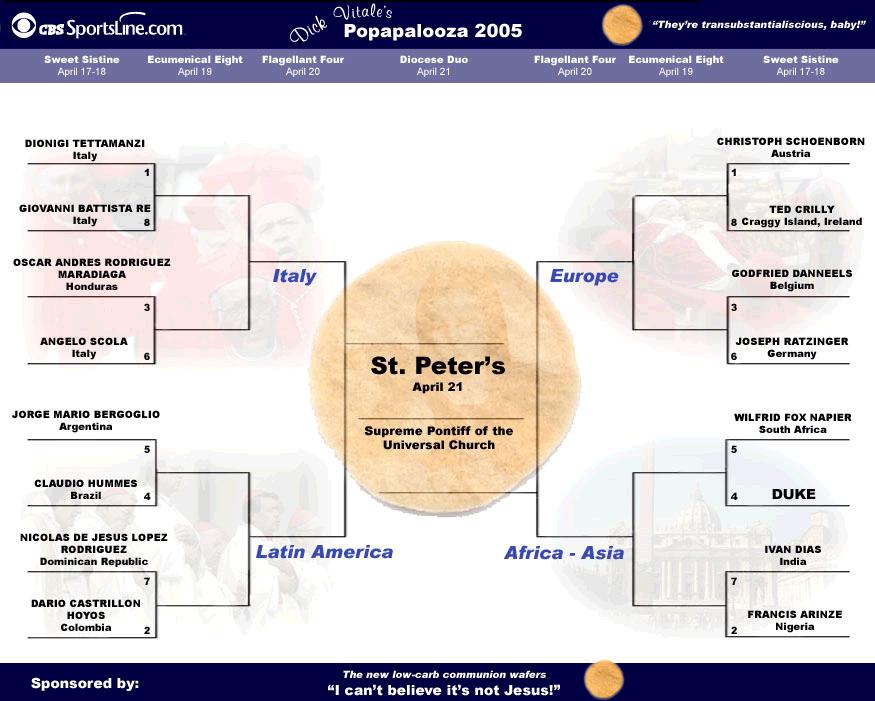
Here is Popapalooza 2005!

:-) [click to enlarge]

A friend sent this to me today, and I just had to chuckle. It's slightly sacrilegious, but I present it in the long Judeo-Christian tradition at seeing irony and humor layered into all of life.

Hopefully it will bring a smile to you...

And, not take away from the seriousness of what is riding on this Papal election.

Let us to our prayers, but with a smile in our hearts!

:-)

Mr. L. D. Iconclastian R. Mershimer

Grin.

UPDATE: Whoever created this and made Ratzinger a 6 seed totally missed the boat! C'mon! No way was he less than a 2, and this only because of age! But he had enough hops in those 78 year old legs to win the day. Grin again. :-)

Saturday, April 16, 2005

Meditation on the covenant sign of life


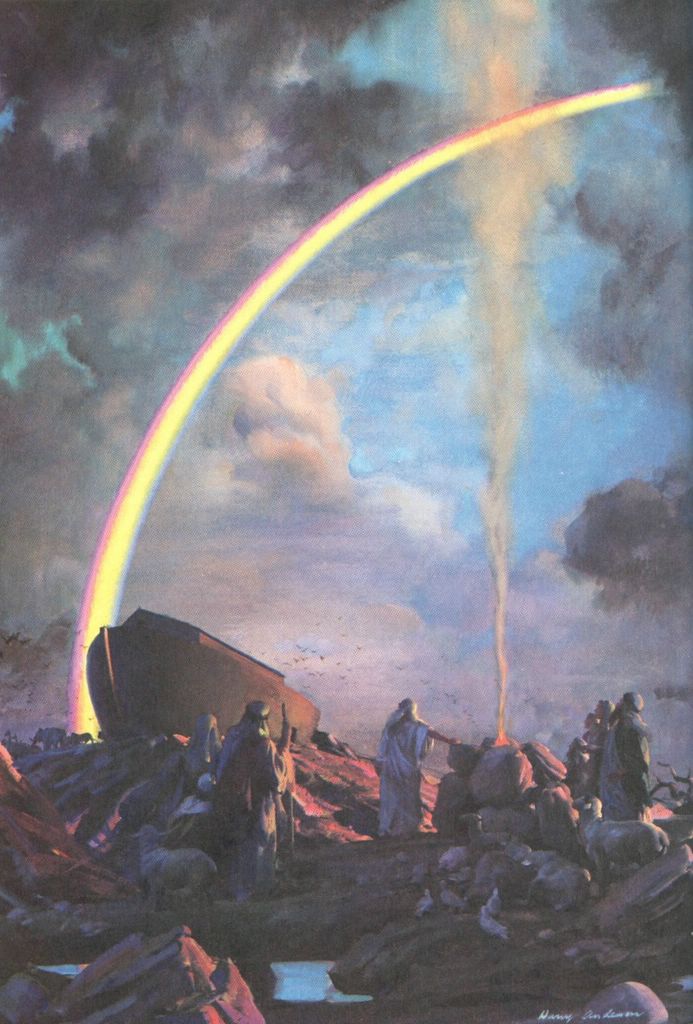
Then the dove came to him in the evening, and behold, a freshly plucked olive leaf was in her mouth; and Noah knew that the waters had receded from the earth.

Then God spoke to Noah, saying, "Go out of the ark, you and your wife, and your sons and your sons' wives with you. Bring out with you every living thing of all flesh that is with you: birds and cattle and every creeping thing that creeps on the earth, so that they may abound on the earth, and be fruitful and multiply on the earth."

Then Noah built an altar to the LORD, and took of every clean animal and of every clean bird, and offered burnt offerings on the altar.

And the LORD smelled a soothing aroma.

Then the LORD said in His heart, "I will never again curse the ground for man's sake, although the imagination of man's heart is evil from his youth; nor will I again destroy every living thing as I have done. While the earth remains, seedtime and harvest, cold and heat, winter and summer, and day and night shall not cease."

And God spake unto Noah, and to his sons with him, saying: “Behold! I establish my covenant with you and with your seed after you, and with every living creature that is with you -- of the fowl, of the cattle, and of every beast of the earth with you, from all that go out of the ark, to every beast of the earth. And I will establish my covenant with you; neither shall all flesh be cut off any more by the waters of a flood; neither shall there any more be a flood to destroy the earth.”

And God said, “This is the token of the covenant which I make between me and you and every living creature that is with you, for perpetual generations: I do set my bow in the cloud, and it shall be for a token of a covenant between me and the earth. And it shall come to pass, when I bring a storm over the earth, that the bow shall be seen in the cloud: And I will remember my covenant, which is between me and you and every living creature of all flesh. And the waters shall no more become a flood to destroy all flesh. And the bow shall be in the cloud -- and I will look upon it, that I may remember the everlasting covenant between God and every living creature of all flesh that is upon the earth.”

And God said unto Noah, “This is the sign of the covenant, which I have established between me and all flesh that is upon the earth.”

Meditation of spirit

I see the descended dove,
Leaf in her mouth:
Above storm, night and fire,
Dove of starlight, dove of life.

Yet I see the darkness, sign of storm,
And I tremble.
So from my altar lifts this smoke:
My sacrifice, prayer, request.

Favor, my God!
Life, my God!
For love, my God!
Your promise, my God!

The heavens are silent:
Darkness, brooding clouds,
Grey, scudding storm --
Smoke, blood, and silence…

I wait, head bowed…
Silence. Darkness. Night.
Then heavens are rent
With crashing, dancing light!

Lord God, what is this?
Sign of favor, sign of life!
Fire in the clouds:
Transcendent hope!

I hold Eternal hand
And the storm passes by --
But with a blessing!
Holy sign, heavenly Light
.

Here on wings of storm,
Mystic peace!
In face of wrath, mercy;
In judgment, favor…

Mercy and truth,
Have met together,
Righteousness and peace
Have kissed each other!

I sing again: Holy sign,
Heavenly dove --
Your heavens are opened
And I dance, for love!

The sign is in the clouds,
The storm carries favor:
The covenant is mine
Throughout all generations!

Alleluia!
Alleluia!
Alleluia!

Amen!

Kierkegaard: Thy life is the judgment

THY LIFE IS THE JUDGMENT

O LORD Jesus Christ, Thou who indeed didst not come to judge, but wilt come again to judge the world. Thy life here on earth is in reality the judgment by which we shall be judged.
Wherefore everyone who calls himself a Christian must test his life by this judgment: to discern whether he loves Thee in Thy humiliation, or loves Thee only in Thine exaltation, or simply whether he loves Thee, for if it is in only one of these two ways that he loves Thee, he loves Thee not.
But if he loves Thee, he surely shall experience humiliation [for he loves Thee in Thy humiliation], but not as when the worldly mind succumbs to humiliation -- for it was not thus that Thou didst walk here on earth in humiliation.

No, such a lover, though humiliated, is raised above humiliation: his mind, his eye being directed to the high places wherein Thou hast entered, and where he looks forward to being with Thee -- who from on high wilt draw all to Thyself
.

THOU ART THE STRONGEST

LORD Jesus Christ, there are so many things to keep us and to draw us to themselves; each one of us has his or her own particular attraction, yet all of us have many.
But Thine attraction is eternally the strongest! Draw us then the more powerfully to Thee.
We call Thee our Redeemer for Thou art come into the world to break our bondage to the vain cares which we have imposed on ourselves, to break the heavy chains of sin!
We call Thee our Savior that Thou mightest save us by freeing us from all these fetters.

For it is God’s will that Thou should accomplish this and make possible our sanctification. That is why Thou hast descended into the lower regions of the earth and that is why Thou hast returned to Heaven in order to draw us to Thine own dwelling place
.

THOU ALONE ART ABLE

Thou alone, O Lord, art able to move a man; Thou alone art able to move a woman!
From the moment I think of Thee, my life is at Thy service; my weak talents are perhaps great in the eyes of men, but for Thee they are nothing and in every case they are the gifts Thou has given me.
When I think of Thy sufferings, Thou, my Lord and Savior, I do not want to spend my days whimpering in a pulpit, but I want to be surrounded by insults, losing everything which is of earthly order -- if it is Thy will.

NOT TO ADMIRE BUT TO FOLLOW

O LORD Jesus Christ, Thou didst not come into the world to be served, but also surely not to be admired, or in that false sense to be worshipped. Thou wast the Way and the Truth – and it was followers only Thou didst demand.
Arouse us therefore, if we have dozed into this delusion, save us from the error of wishing to admire Thee instead of being willing to follow Thee and to resemble Thee
.

This we ask for Thy kingdom’s sake O Lord, and for the glory of Thy name!

Alleluia!

Amen.